
Back in the Slack YVR
Returning to Vancouver. Resetting with Slack YVR. Getting out to SF, NYC and onwards.

We landed back in Vancouver on Canada Day, July 1, 2017. Our home for the next month was a top-floor Airbnb suite, looking out over a grassy park, then out over the waters of English Bay to the north shore mountains.
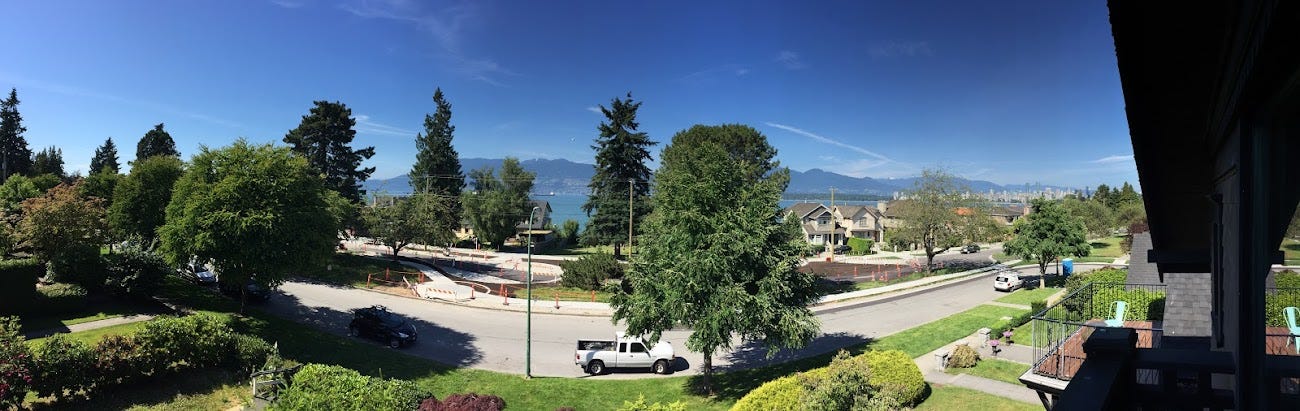
I remember opening the sliding door that first morning back, early after a short sleep, still on a transatlantic time zone, and feeling like we had made the right decision to come back. The air smelled sweet and dewy. The dawn light fell soft and purplish over the water as the sun rose.
Had we really considered moving to San Francisco or New York where Slack’s Executive Briefing Centres were located? For a few seconds, yes. We could have continued our international adventure and immersed ourselves in the thick of the struggle. We could have been at one of the centres of the action. But not really.
Our son returned to Vancouver as a 4-year-old with an Irish accent. He said, “budder” which he spread on his “tost” and put his crumbs into the “rubbish bin.” He had kindergarten entry coming up. Life decisions felt like they demanded we put down roots and Vancouver felt like the place we want to be, to be back to.
I have always found returning to a city can be a bit conflicting. Is it the same or not? Yes and no. What has changed? What has stayed the same? Will it still feel familiar and like home — even though you may have changed?
When people asked about Vancouver I frequently told them that it’s a city of 2.5-million people where there shouldn’t be a city. The mountains and ocean and rivers make it hard to build. They dwarf anything that does get built. Compared to some cities it’s small. Compared to other cities it’s large. Taken for itself it’s a mirage of a city at the edge of a continent. And now, living there again, it felt like our home.
Home Again, Home Again
After a few days getting settled, I rode my bike in to the Slack office to get back to work. The location of the office remained the same as the location I had left, yet everything was bigger.
Where we had occupied 1 floor, now we occupied 3 floors of dark desks and glassed-in meeting rooms. At some point we had punched through the third floor to join it to the fourth in a gathering area with bleacher seating. The 18” x 18” solid Douglas Fir beam that had been removed became a coffee table in a common area.
Each team in the office had grown and staked out areas on their respective floors. Design and engineering on the 4th. Sales and Customer Success on the 3rd. Customer Experience and Product Support on the 2nd. The kitchen pulled us all together for coffee, snacks and weekly lunches that occupied a large role in our collective imagination and office culture. We went hard on lunch.

A taco shop had opened on the main floor of the building. Our back stairwell provided us immediate access to their facilities so we could keep up our strength. A gym and a bike room lived in the basement with showers and a locker room. It never didn’t smell a bit musty but it also proved a terrific luxury for those of us who cycled in or wanted a quick workout.
And who filled that office? So many of my favourite people. Old teammates who had grown. New teammates who I got to know as consistently upholding the standard of how good our people could be. The place felt familiar and fresh at once.
And I mean that as no bullshit. The people at Slack continued to be amazing. Product support experts. Sales development representatives. Interactive designers. Javascript engineers. Each got a lot asked of them and each excelled in their job.
It’s the People, Again
Are you tired of hearing me talk about the people at Slack? I’ve certainly gone on about them. Way back in June, 2013 it had been the first reason I joined the company. It was my answer to Stewart when he asked back in Dublin what made Slack so special. It’s still what I remember years after leaving. And I’d still say it’s true — it was the people that made the place so special.
So I’ve likely banged on about it enough. But let’s dig in a bit more to some questions that led to the exceptional people.
For example, when they got hired at Slack were the people of Slack already excellent at their respective jobs? Maybe. They certainly had some solid track records to get hired in the first place. They were probably pretty great.

But I think each of us who worked at Slack would also agree that something at Slack contributed to our excellence at Slack. Something about the overall challenge the company faced, the humane way we approached work and the luxury of resources (time, people and money) we had as tailwinds but mostly never took for granted. The way we communicated with each other. The formalized and informal ways we worked together. The common mission we seemed to share and each be happy to contribute to. For lack of a better word, the company mission.
Slack people were terrific and Slack made each of them better too. I’m a pretty firm believer that all the tailwinds we felt made each of us better at our jobs than we could have been in any another situation, at any another company. They certainly made me better that I would have been elsewhere.
Each of us worked in our own jobs and did them well. That’s pretty basic and expected. The bonus multiplier was that each of us also had a pretty rich inclination towards learning more about how we could do our jobs better. Then we each talked to each other. Ideas spread, got challenged, got cross pollinated with related ideas. You get it and it compounds. Lots of smart people working hard to get better together acted as both rocket fuel and catnip.
To provide a bit more context on how the environment drove the excellence, I can only recall one person ever not measuring up and needing to be fired. They made the mistake of joining Slack and ending up more inclined to being extractive than we were. Too much mercenary, not enough missionary.
Much more commonly people got poached to other offices and leadership roles within Slack. The company grew and these folks grew into new spots in the company.
Here’s a quick incomplete list of examples from Slack YVR. Tom Forgacs went to NYC to lead up large enterprise sales. Mike Clapson went to open our APAC HQ in Melbourne and then to SF to lead enterprise sales. Marc Henry went to Toronto to open Slack TOR and lead sales expansion. Kim Graves moved to SF to lead SMB sales for all of North America. Christina Meng moved to SF to lead our Customer Success scale programs. I’m sure I’m missing others who excelled.
Coming back to Slack YVR and seeing all these folks succeeding elsewhere could have made Slack YVR feel like a bit of a minor leagues. Like a branch plant of the actual work happening in bigger places. Like the B team. Like being on the periphery. Yet it never felt like that to me and I don’t think it felt like that to anyone else.
Sure, a lot of leadership roles got vacuumed up by HQ in SF. That happened as soon as Slack started to scale. And certainly lots of folks from Slack YVR travelled down to SF (and to other Slack offices) pretty consistently to drink the coffee, bask in the sunshine, get the good word from on high and collaborate with teammates. But the feeling I consistently got at Slack YVR was that everyone felt really happy to be at Slack YVR.
The sniff test for me that this feeling was legit is that it got talked about not just by the folks who worked daily at Slack YVR, but by the folks who visited from other Slack offices. I heard many teammates from SF or NYC say they went to Slack YVR to get work done. I certainly felt that way. It was quiet, calm and connected to the maelstrom, all at the same time.
Being on the margin didn’t mean Slack YVR was marginal. Rather, I think it meant that from Slack YVR you could get perspective. You were outside the centre of the tech universe in SF or NYC, and that gave you a chance to see a wider perspective for deeper work. The buzz of the newest new thing dulled by distance. That perspective, combined with a historic density of talent and experience, meant Slack YVR always felt like home for me.
And so I returned and started a new chapter of my Slack journey. Back in Vancouver, feeling reunited with home, yet working mostly in San Francisco and New York.
Onwards to EBCs
We settled back into Vancouver and I settled back into a bit of a routine. When I started my 5th job at Slack I mentioned that I faced a pickle of setting — I lived separately from where I needed to do my work. Sure, Vancouver was closer than Dublin, but still it called me to travel.
So every second week or so, I flew down to SF for work. Every 5th or 6th week, I flew to NYC for work. I started to know the flight schedules and found some favourites. I started to navigate the best paths through the airports. I found the decent food options. I collected points. I became that creature of habit and optimization, the business traveller.
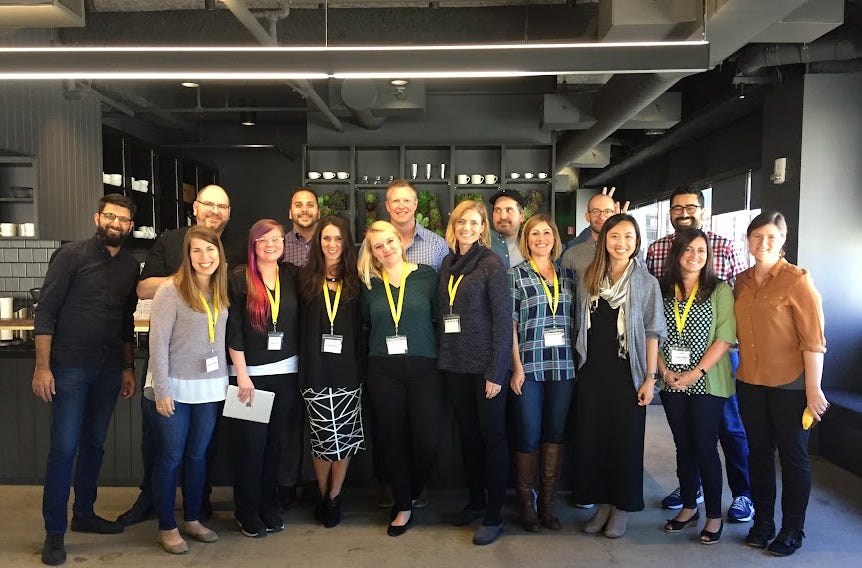
Each visit to Slack SF and Slack NYC felt like a snapshot of Slack overall in hypergrowth. That growth drove a kind of strobe light effect to each visit. Everyone at Slack SF was in one office on 5th avenue. Next visit Slack SF was split into 3 offices within a few blocks of each other. Slack NYC had a whole vacant back half of the office. Next visit that back of the office hummed with activity and calls and new faces.
I felt a bit like a stone skipping across the surface of Slack. My new boss Marnie and I started to build out some programs and started to build some awareness of how we could work with the sales team to achieve their goals. We started to create some believers with our EBCs and word started to spread. We educated the team. We promoted what we could do. We tried to be flexible while still sticking to a vision with a clear heading.
And I found I really started to enjoy the work and (of course) the people. But wait — I’m getting ahead of myself again. Let’s leave it there for now.

Up next: Becoming a Senior Technology Strategist — Making up the job as we went. Finding Innovation Tours. Being the Slack man.