
Innovation Tours
Harnessing our story. Finding a new decision matrix. Building a culture of innovation.

Innovation Tours? Yes, that’s right. A real thing. Like cycling tours for middle-aged athletes. Like wine tours for gourmands. Innovation Tours for executives at global companies scratched an itch. And that itch that companies wanted to scratch? The anxiety that they were not innovating and needed to visit the heart of innovation in Silicon Valley.
Let me unpack that a bit.
To start, demand for Innovation Tours came to us. The world reflected back to us what we had been telling it: Slack was an innovator. Huzzah. Our PR was doing a brisk business.
People wrote to ask if they could they bring their Innovation Tour to visit Slack’s offices. To see the sights. Wander the halls. Take the innovation air. Along with other companies of the moment — Dropbox and Google and Uber — folks wanted Slack to be a stop on their Innovation Tour.
Really? This was our first reaction. We didn’t know how to respond. What was an Innovation Tour? Who were these folks? Why might they want to visit Slack? Why might we want them to visit? How did it all work? We tried to learn more.
We learned Innovation Tours came in many flavours. Sometimes the Innovation Tour was being run by a company (Daimler or AstraZeneca or Bosch) and the tourists were its employees. Sometimes it was run by a government agency (The German-American Chamber of Commerce, La Loire’s regional economic agency) and the tourists were its constituents. Sometimes it was run by a consulting company (Accenture, ThoughtWorks, Bain, BCG) and the tourists were its clients.
Most often, the Innovation Tour was run by a company that specialized in Innovation Tours. The whole company focused on it. They might also have added expertise in programming and education and corporate events to go along with the innovation tourism, but it was the Innovation Tours they specialized in.
We met companies like Austral Education Group, WDHB, Flyn, 10x, SVIC and many more innovation tourism companies. Often they called the Innovation Tours Journeys or Missions. They worked with large companies to create themes for the tours, driven by the specific innovation issues of the client, then filled the itinerary with experiences to address the theme (company visits, workshops, guest speakers, etc.). They tapped into budgets for executive education. They knew their business and I grew to respect their expertise and niche.
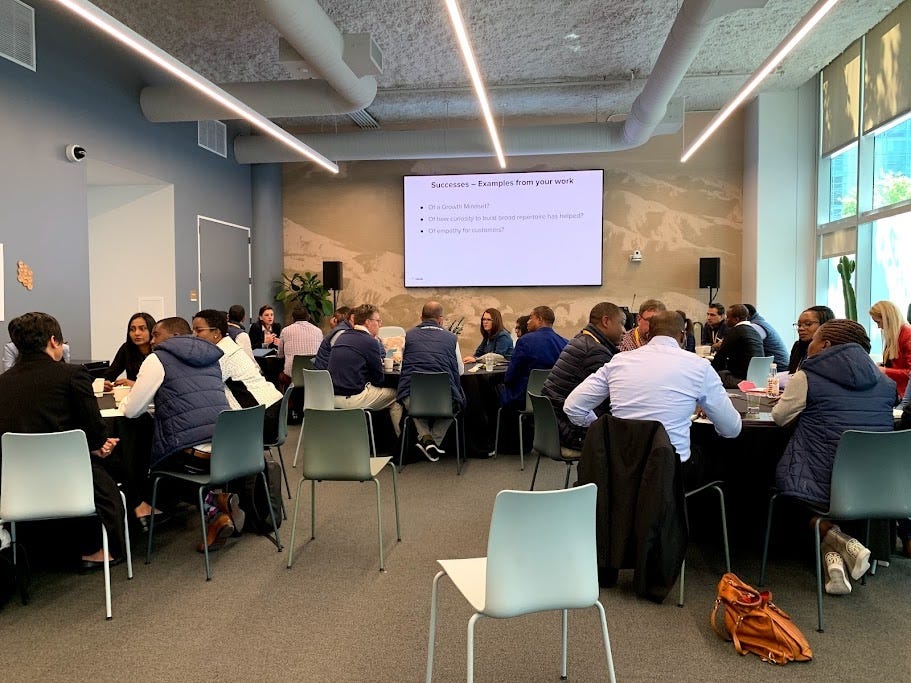
Now you might be thinking, how big can this really be? Is this a whole boutique industry? And I assure you, it is. If you run an irrigation company in Winnipeg with 30 seasonal employees like my friend Jeff, an innovation tour might sound mostly like a boondoggle. And it could be. A few folks on the tours treated them as such and showed up hungover.
But if you worked leading an innovation team at DENSO in Aichi, Japan — established in 1949, creator of the QR code in 1994 — and you wanted to see first-hand how business could work differently, an Innovation Tour could be a valuable and educational trip to see how Silicon Valley worked. Or if you led the software and systems teams at Airbus in Blagnac, outside Toulouse, France, an Innovation Tour could also act as a reward and team building event for a tiny subset of your 147,893 employees who have met a goal.
In short, we learned that an Innovation Tour could morph to serve many needs, connecting the tourists’ perception of their old thinking to the challenge of Silicon Valley’s new ways of thinking.
And as our profile grew, the volume of inbound inquiries for innovation tours to visit Slack kept increasing. So how could that become an opportunity for us?
We felt pulled in opposite directions. Saying No Nicely was something we had practiced to good effect in many domains for many years. We liked to stay simple and stick to our knitting.
But acknowledging that What Got Us Here Won’t Get Us There also meant we had to keep changing. So we decided to say yes and do some Innovation Tours.
Return of the Matrix
Like so many things we did at Slack, at first we tried to listen to the world and learn what it was telling us. Then we tried to find the easiest path to finding out if our ideas about what we thought we heard were real. We started small and validated our assumptions. We sought evidence outside our own wishful thinking.
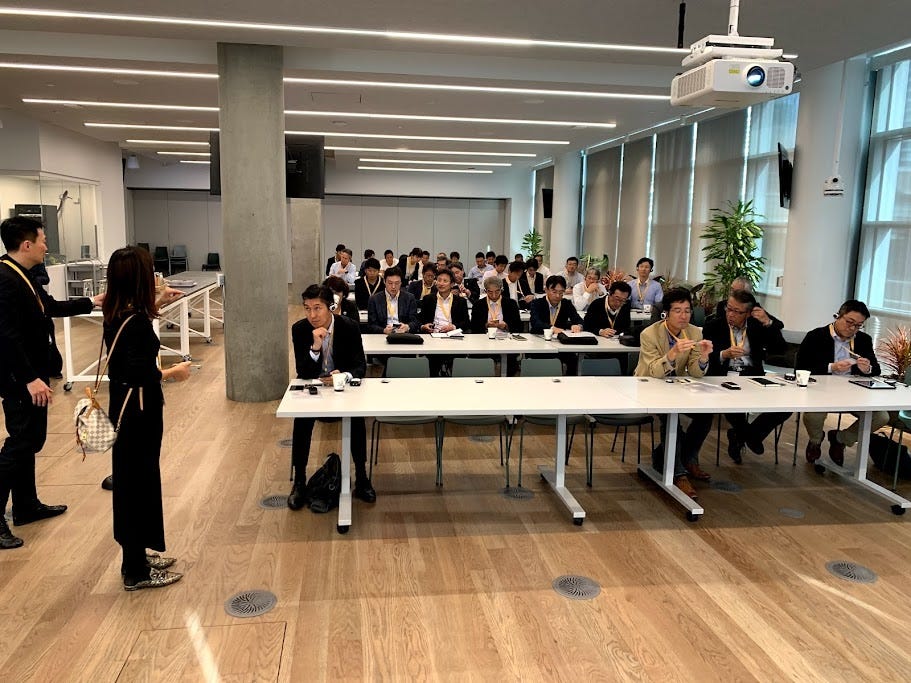
And I confess, before we had any kind of corporate program for Innovation Tours, I had dabbled a bit. I got forwarded some inbound inquiries and said yes to a few. A team of ~20 innovation leaders visited our Dublin offices as part of an Accenture group. They wanted to learn about Slack’s culture, so I did an office tour and presentation for them that highlighted elements of Slack’s culture.
But could Innovation Tours actual be valuable for Slack’s business? I felt suspicious and like I needed some defensibility and rigour in my process if I was going to consistently say yes to doing them. So I started to track the people and organizations who visited and then reviewed how they affected sales. This tracking was the digital equivalent of digging a ditch with a shovel — inelegant but workable — and it helped see the results from Innovation Tours after they happened.
But that was a long lag to decide what ones should we host. So I revisited an old favourite decision making tool — the 5-factor matrix. Just like when we started hiring people, we had many factors we needed to weigh in decisions that we hoped were the right factors.
When I hired the first 5 sales people at Slack I had evaluated candidates on 5 factors — communication, integrity, poise, savvy, grit. What would the equivalent 5 factors be to evaluate Innovation Tour groups? Here’s where I landed:
Organization size — How big were the employer(s) of the visitors? Bigger equaled better because Slack billed by users.
Opportunity size — Did we have a deal in process with visitors? Did we have a past deal with visitors? Again, bigger was better here but we also kept an eye on new industries and upside over time to be found.
Slack usage — Did they have any? How much? More usage equaled better prospects. We also wanted to say yes to existing Slack customers.
Slack propensity — Did the people of the group seem likely to use Slack? Did they come from a strong Slack industry / company / region? White-collar, tech-focused organizations in WEIRD countries were best.
Participants seniority — Did the participants make decisions at their organization? Did they make technology decisions? The more decision makers we could connect with, the better for our business.
Just as with Sales roles, I scored each of the 5 factors out of 5 points (higher = better) and added up the scores. Scores of <15 were automatic Nos. Score of 16-20 were Maybes that needed a reason to get approved. Scores of >21 were automatically a Yes as long as we could make the logistics work.
I called the spreadsheet an Innovation Tour Scorecard, with capital letters to make it sound official. An added bonus I had not anticipated from the Scorecard is that it also served as a decision journal for our past judgements so we could see if the factors we considered mattered and if our decisions made sense. Spoiler: they did and they did.
We added every invitation we received to the spreadsheet so we could also see the ones that scored too low and that we declined, and we declined about twice as many Innovation Tours as we accepted.
Okay, so we had a process in place and some accountability. All we needed now was a memorable, meaningful story to tell guests on our Innovation Tours.
Harnessing Our Story
Right from the start we had lots of advantages to make Innovation Tours work. The PR work our team had done set the stage with our public story. People arrived with some awareness and a positive sense of Slack. Our offices were lovely courtesy of our global facilities teams.
And our story was rooted in innovation, right from the start when our CEO had laid down a great quote to build on:
The best — maybe the only? — real, direct measure of “innovation” is change in human behaviour. In fact, it is useful to take this way of thinking as definitional: innovation is the sum of change across the whole system, not a thing which causes a change in how people behave. No small innovation ever caused a large shift in how people spend their time and no large one has ever failed to do so.
— Stewart Butterfield, We Don’t Sell Saddles Here
So how to put all these ingredients together and make something remarkable?
To start, the groups expected a tour on their Innovation Tour. So tour them about, I did.
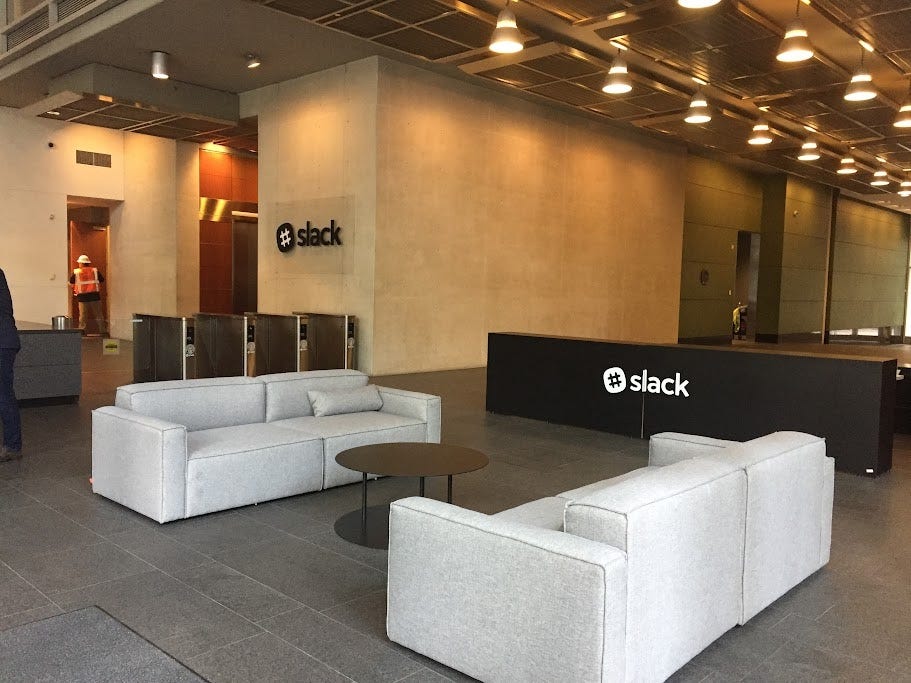
I met our groups in the Slack HQ lobby in SF. We had a 10-storey building full of Slack people and work and all the physical infrastructure and cultural manifestations that made that possible. People wanted to see it all. But no, that would have been impossible. So we focused on hitting some highlights and leaving them wanting more.
The first stop, once everyone was signed in, was Everest. Everest was a literal photo of Mount Everest in our lobby. It was huge. In memory, I’d guess 8’ tall by 12’ wide, shot from a satellite and incredibly high-resolution. It made you feel small. I gathered the group close to it for the full effect. I asked them to focus in on a detail. Minuscule among the rock and ice and snow we could see a few dashes of colour — yellows and reds. That was the Everest Base Camp. We still felt we had Everest to climb in our business. That metaphor was where we started.

The tour continued upwards. We visited the all hands and lunch space to show them how Slack came together over meals and meetings. We stopped at the library on 5 to show them quiet spaces for contemplative work. We passed artwork, poked our heads into meeting rooms. I had talking points on design and enabling everyone to do the best work of their lives. I mentioned the use of light and plants and oxygen, how meeting rooms mostly had been built on inside walls to keep outside windows available to everyone. Guests asked about our desks set up — did each one adjust seated to standing? Yes.
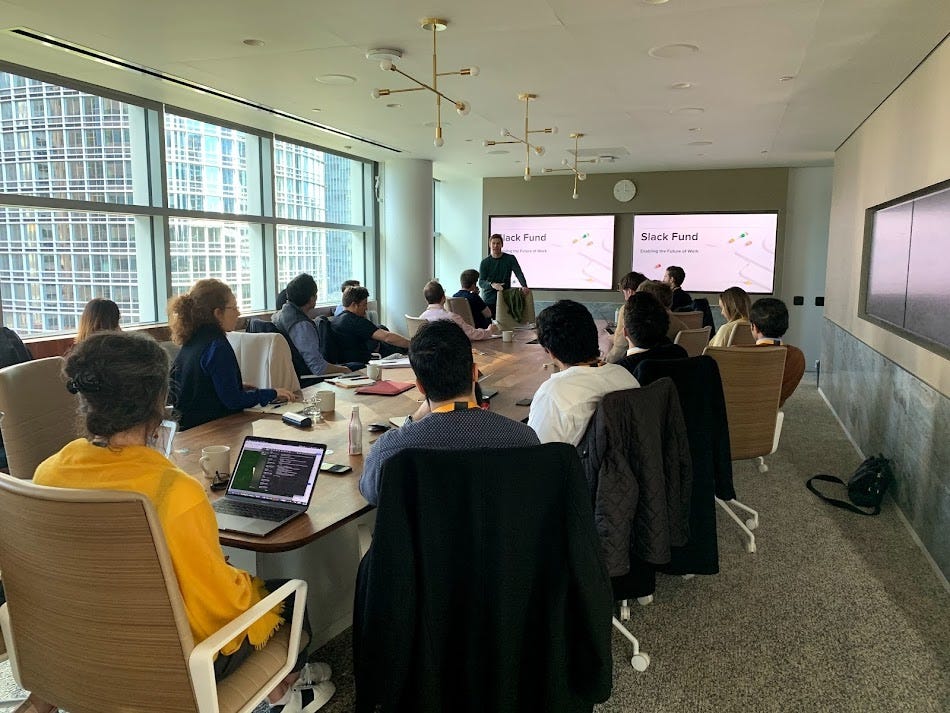
We eventually ascended to 10, where a coffee bar awaited, sun lit and ready to make cappuccinos and affogatos. I showed them into our Executive Briefing Centre (EBC), a lovely corner meeting room, windowed on two sides and prepared in all ways. I let folks put down their things, get settled in that room, and invited them to place their coffee orders with the baristas. Maybe I showed them the secret mezzanine lounge. One of the top questions was always directions to the bathrooms.
Through all this it felt like all of a sudden we were running a hospitality business. When we had started as 3 people in a Vancouver office we’d talked about Four Seasons’ customer experience as an inspiration, something we aspired to but delivered in a software experience.
Now we had to drop the metaphorical distance and apply that inspiration to actual place making and hosting for people IRL. I suppose the name Innovation Tours should have tipped us off.
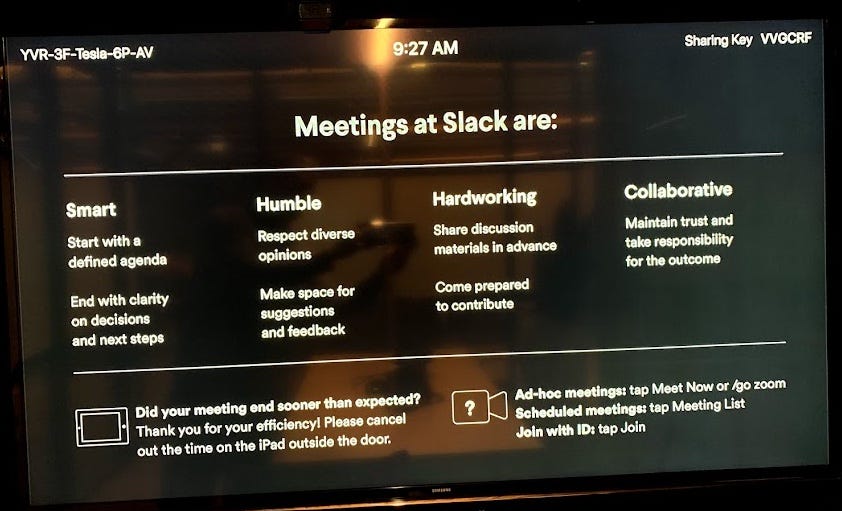
Do you care about any of this? Maybe. Maybe not. Same as our guests. As we were immersed in it, we felt our approach needed to match up to the experience we expected from our software. A lot of complex and detailed work had to happen behind the scenes to make the experience of the guest simple, smooth and coherent. We had to strike a balance between security and hospitality, sharing details and overwhelming tired travellers.
If everything went well, maybe no one would even notice any of the sweat that went into the user experience. We’d skate by on the sprezzatura of it all.
5 Lessons from Building a Culture of Innovation
Now that we had our guests suitably introduced to Slack — arrived, toured, caffeinated and curious — what story did we want to tell them?
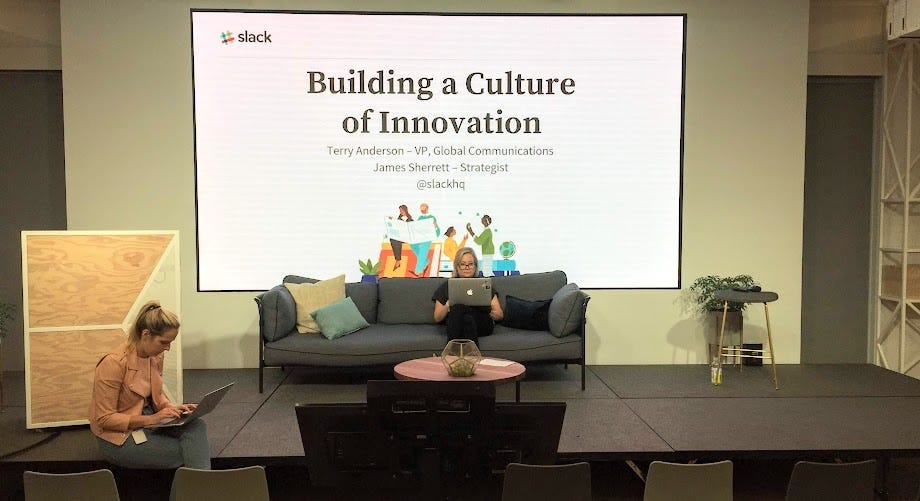
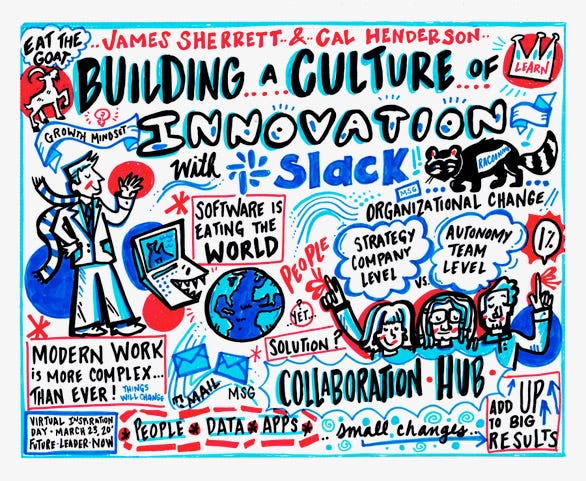
I created a presentation called Building a Culture of Innovation. Over the years I delivered it many hundreds of times, and it evolved as I gave it. Other folks delivered it too, often with their own spin and stories included. I’m not going to include the whole presentation here (Boring! Leave a comment if you want it.) but I do think I learned some valuable lessons doing the presentation so many times.
Here’s the top 5 lessons I still return to and share with folks:
No one remembers what you say. They remember how you made them feel. This has been said so many times and yet still bears repeating. That’s why we felt we were running a hospitality business. How do you want to make people feel?
Assume no one knows you. No matter how good your PR, assume folks don’t know your story and you’re going to have to start at the beginning. To make this concrete, I often would ask a group, hold up your hands, 1 finger is not at all, 5 fingers is really well, and tell me how well do you know Slack? There was always a range of answers. Great. Then I had the chance to say, let me start at the beginning and do an introduction (or reintroduction) so we’re all on the same page and can go forward together.
Contract the talk. You’re making a deal with the group — they’re going to pay attention and you’re going to reward that attention. But for what? I liked to do this on the agenda slide, right after I established the need for an intro because of the range of answers to how well folks knew Slack. I showed a 3-item agenda and asked — is there anything anyone wants included not covered by this agenda? Sometimes people asked for something specific and I’d make a note to cover it. Most times everyone was happy with the agenda. In either case, it gave the audience a say in the proceedings and then let us all move on together with an agreed-upon structure. Okay, let’s go.
Rule of 3s. It just always works. Three main presentation sections. Beginning, middle, end. Three subsections within those main sections. Job done. Unless absolutely essential to deviate, I always defaulted to using the Rule of 3s. It’s simple, clear and effective.
Include subject matter experts. I always loved to have someone else to present with me. It kept the content fresh and the guests engaged. It also made it simple to bounce ideas off each other and build on points with each other. I asked my experts to tell stories from their working life at Slack, to show how they used Slack. Folks loved to see behind the scenes and all the details of both good and bad stories, lessons and mistakes. If live experts aren’t an option, include videos.
I could go on for some time about the above lessons and more. I learned a lot leading the Innovation Tours at Slack. It’s a deep vein I thought about often and took pride in doing well. All those reps gave me a ton of practice too.
And I should also mention that in addition to the tailwinds that benefitted our overall business, I had a huge personal luxury. No one at Slack was paying attention to what I was doing. No one asked about my presentations. No one approved my presentations. No one told me the story to tell. I sewed together the Building a Culture of Innovation story from many threads: Carol Dweck’s Growth Mindset ideas, sales presentations, game theory, Calvin and Hobbes comics, Steve Jobs videos, change management books.
By 2019, my last year at Slack and the last year before the COVID pandemic closed down Innovation Tours, we had 3 Strategists doing Innovation Tours. We delivered over 50 Innovation Tours at Slack offices around the world and introduced Slack to 550 global executives. It felt kind of like found money — an unexpected $20 you discover in the pocket of your jacket. My janky tracking reported we closed 29 deals in 2019 that started with Innovation Tours.
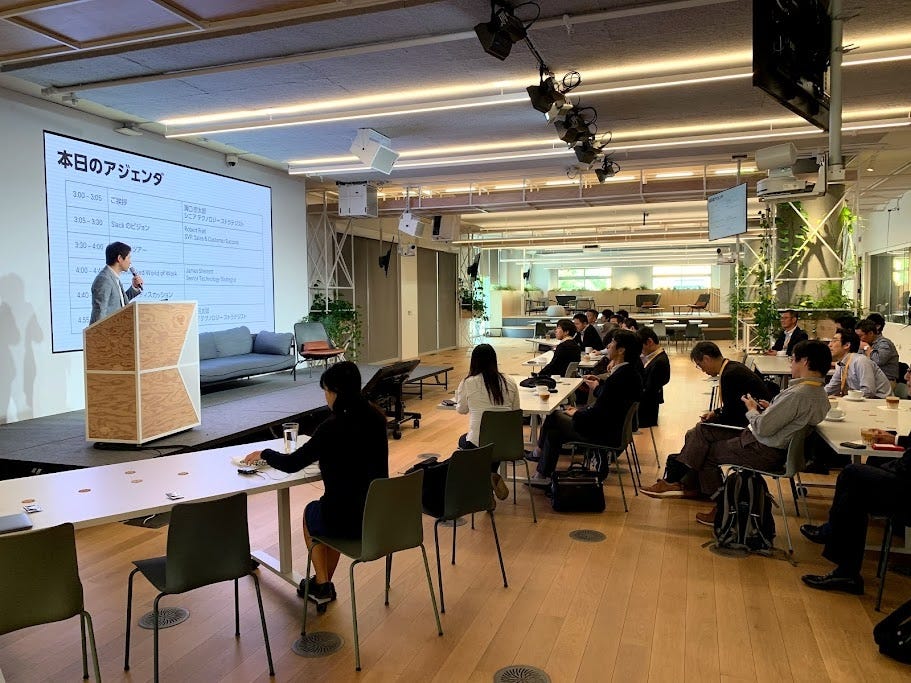
So something was working. The Innovation Tours deals came from slower developing leads, in deals over the course of quarters and years, not weeks and months. But we had faith that the more we did, the more we’d close. The more chances we had to tell the Slack story, the more chances we had to build the value of collaboration inside an organization and be part of prospective customers’ future options.
Or, as we put it internally, to infect our visitors with a mind virus. Once exposed to it, they couldn’t be inoculated against it. The specific mind virus we wanted to infect them with? That collaboration — how well their people worked together — was the highest priority any organization could work on, and Slack was the clear leader for enabling collaboration.
So from nothing, we created something. From taking a chance and listening to the world, we built a new source of business. And from an unnoticed market space, we found our story of innovation.

Up next: Pocket Squares — Falling for swag after socks. Finding a new partner. Fooling myself with options.