
Stories I Haven’t Told You (Yet)
Finding our Frontiers. Almost getting PIP’d. Accepting less ambition.

But first, a quick check in. We’re getting close the end. Back at the start I said I’d tell A Slack Story in 50 chapters. Well, I fudged that one. We’re up to 55 now, with a few more to go. But the end is in sight. So what then?
I’ve got some ideas. But I want to hear from you too.
Please take 1 minute and tell me what you’d like to see next from A Slack Story.
Okay, onwards to some stories I haven’t told you, yet.

Finding Our Frontiers
The software marketing playbook is very clear on this one. Once you reach a certain size, you start a conference. That conference brings together your customers, your partners, your product and your team — all your key groups of people.
The tone of the conference can be revealing and depends on the company. It could be an immense, sprawling and crawling fest like Salesforce’s Dreamforce. It could be niche and technically focused like Okta’s Oktane. It could be nerdy and striving to seem important like Twilio’s Signal. There’s some variance and latitude on how you direct the conference and how you signal your values.
But however you shake it out, you reach a time when you simply must create a conference. At Slack we knew it was time when customers started asking about a Slack conference. They wanted more Slack and they had a professional development budget to spend. So starting in 2017 we created Frontiers.
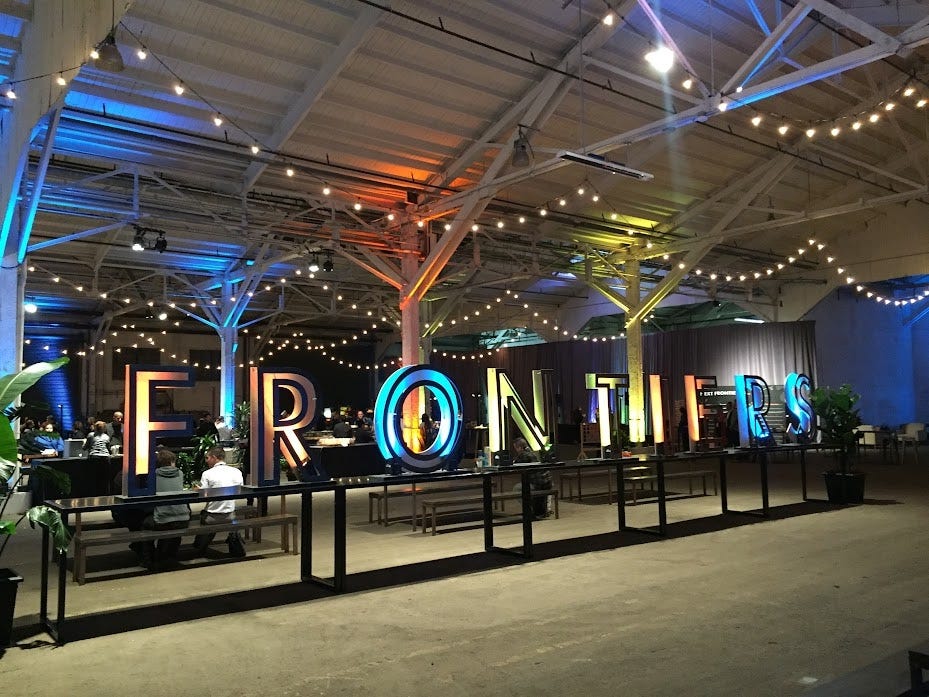
On the waterfront of San Francisco, in a cavernous shell of a cruise ship terminal, we set up a full conference experience: Slack product demonstrations, Slack customer stories, Slack tech talks — Slackity, Slack, Slack, day after day. It sold out in a few weeks and we did it again in 2018 and 2019.
For those of us focused on customers, Slack Frontiers created a compelling event to drive urgency on pretty much any timeline. We had found a persistent reality of corporate life — so much can happen because there’s a deadline and not much often happens without a deadline.
So if we could create a deadline, then we could make things happen. And so we did. Frontiers became a deadline. Is that ironic for a product called Slack?
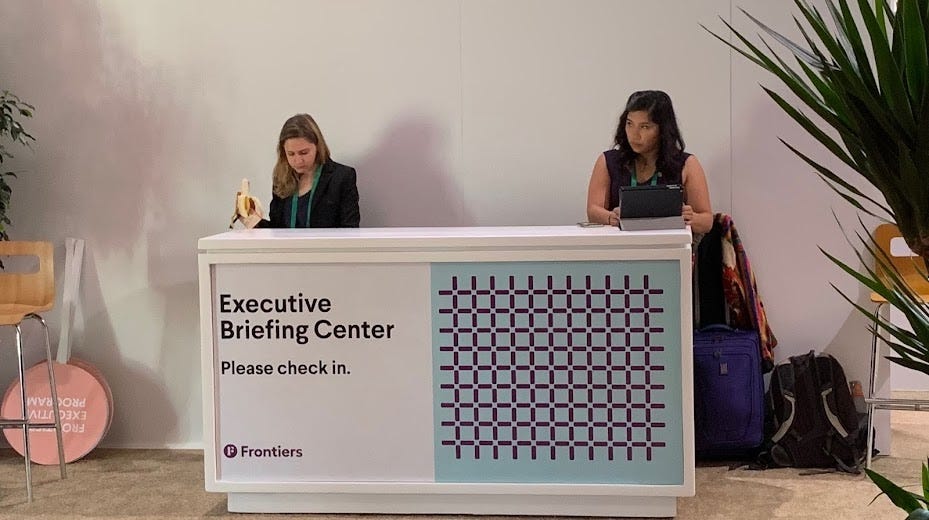
By 2019, my last Frontiers conference, we had a full executive briefing program in place on site. We ran dozens and dozens of briefings each day, whisking folks into temporary rooms built for purpose, creating a cyclical ceremony of improvisation, juggling, chasing, calming words and then lining up to do it again.
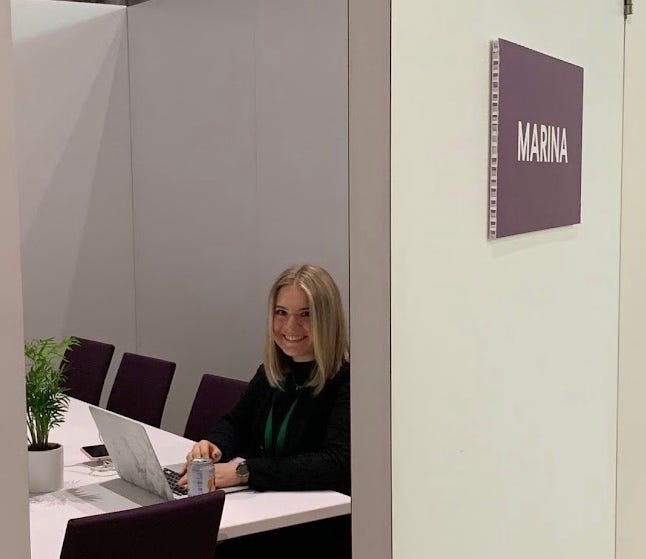
Overall, Frontiers proved eclectic, delightful and a bit weird. Stewart interviewed Serena Williams on stage. A marching band closed a day of programming. Falcons and owls patrolled the oceanfront exteriors of the venues to scare away the seagulls. I have so many vignettes of those intensive days — conversations in snapshot, moments that anchor the experience. Meeting with Goldman Sachs tech leadership team and realizing the pitching was bi-directional: they were selling to us as we approached going public as much as we were selling to them.
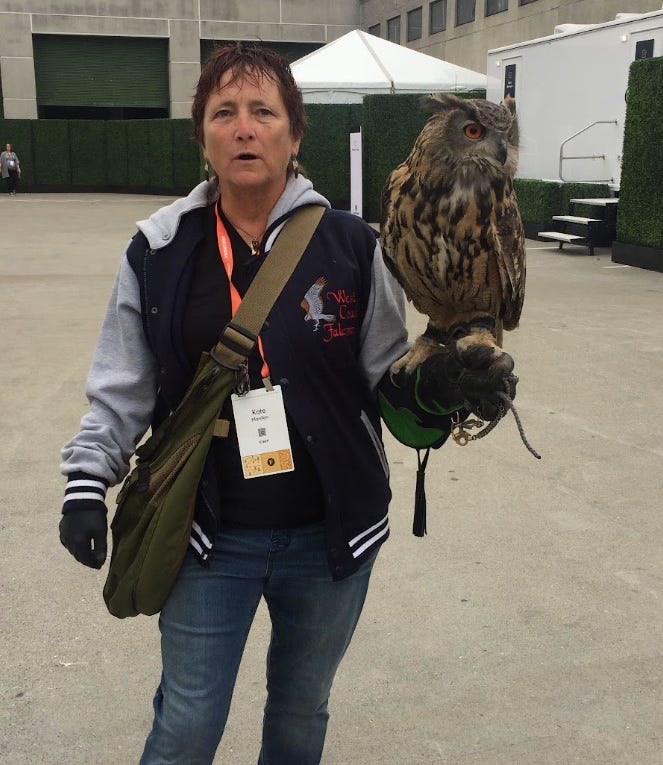
The end of each Frontiers left our teams with a hangover of exhaustion and the glow of a job well done. We had gathered a few thousand customers, partners, media and other Slack-interested folks in one place for a few days and tried to maximize the progress we could make for the business with each of them. Every moment felt jammed full of ambitions and each evening we felt the elation of wringing the best from the day.
So one question you might be wondering — why call it Frontiers?
Stewart presented a Carl Sagan quote at the very first conference that acted as an orientation point to start our journey:
“We’re the kind of species that needs a frontier, for fundamental biological reasons. Every time humanity stretches itself and turns a new corner, it receives a jolt of productive vitality that can carry it for centuries.
— Carl Sagan, Pale Blue Dot
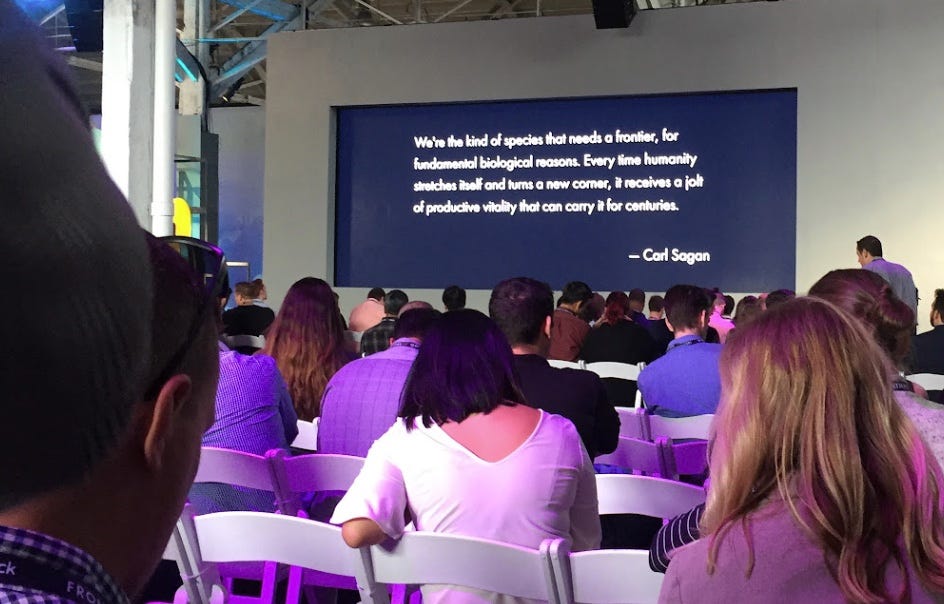
We wanted to think big and shoot for the moon. I’m sure it also helped to think of the aspirational elements of frontiers as an overt nod to US mythology, a western frontier and manifest destiny and man on the moon and so on.
The Sagan quote continues for two more sentences in that paragraph that Stewart didn’t include on his slide: “There is a new world next door. And we know how to get there.”
I can see why he omitted those lines because I’m not sure we totally knew how to get there. But I do feel good saying that we tried hard to find how to get there, along with our customers.
Almost Getting PIP’d
PIP: short for Performance Improvement Plan. Given to low performing employees to get them sorted out and on track (or back on track). Could also be the first step in managing them out, a euphemism for firing them with a track record of evidence to back up your decision.
I know about PIPs because I had delivered them to employees not meeting expectations. Sometimes they were hard conversations. Most often they were really good conversations that made explicit and overt an ongoing concern, and formalized a nagging worry into a codified process.
I also know about PIPs because Marnie brought the topic up in one of our 1:1s in January, 2020. She brought it up as a warning to me, meaning, I was on track to be on a PIP if I didn’t improve my performance. Who, me?
That came as a surprise. But really, should it have been?
I’d been coasting along pretty loosely. Logging in and keeping up but not really pushing much ahead in any way that needed to happen. It felt hard to keep motivated and focused on pushing myself.
We’d gone public in June, 2019. We’d kept running our programs — Executive Briefings and Innovation Tours and so on — through the balance of 2019. I felt pretty comfortable and pretty complacent. Not much felt urgent at all. But that wasn’t what my role needed. It needed some restlessness for new initiatives coupled with execution on the existing ones. I was just doing the second of those things.
So I had to reset after that PIP conversation. Did I want to be on a PIP? Nope, not at all. Did I want to be complacent or comfortable? Sometimes, maybe, but not overall.
It was time to give myself the hard word. Time to refocus. Time to say, hey buddy, figure out what you really want to do with your time and your contributions here. Don’t let it snuff out. Decide on how you want your story to go.
Accepting Less Ambition
At certain stages in my Slack journey I was challenged to accept less. To take on a smaller role, rather than a bigger role. To have a new person join the company and take over something I had done or aspired to do, or something I thought I could be good at doing. To be given a new boss without any say in the matter and to accept it.
Perhaps you’ve noticed this reading A Slack Story?
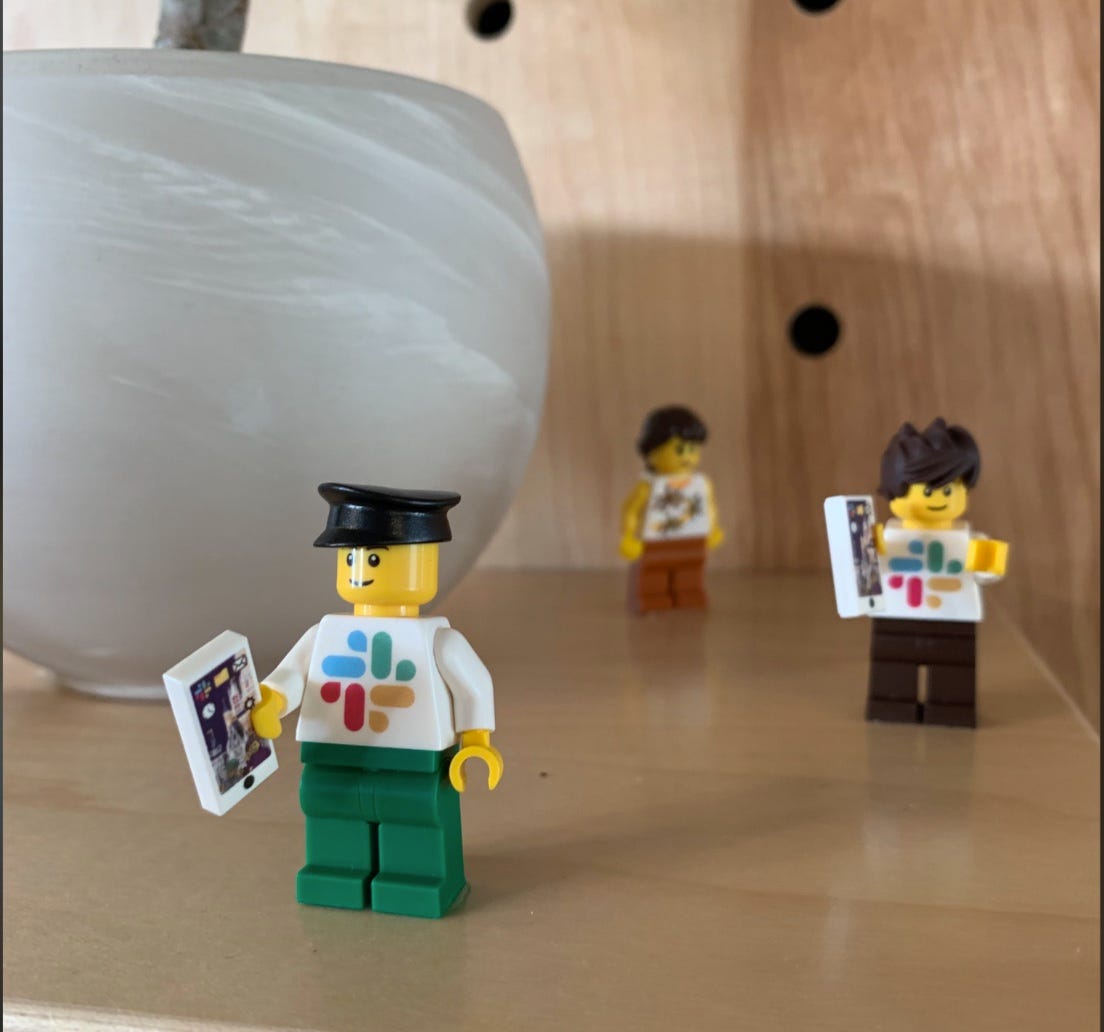
I won’t pretend that this was always easy. It was not. Each time, it was hard to give away my Legos.
I felt attached to things and invested in my work. I had ambitions and wanted to lead and play a leading role. I thought I had shown I was pretty good at some things. The internal and external feedback often seemed positive. I thought we got good results from the work I did and, turns out, hey hey, proof outside of what I thought showed we did consistently get good results. For each role I had at Slack I can trot out stats and stories of success. If you want that sanitized and rosy perspective, check my LinkedIn page.
But from a distance of time and perspective I could also look at my Slack journey as one of consistently getting demoted to smaller roles with less responsibility. That’s another important perspective that sticks with me and I think reflects what it’s like to be part of the journey of a fast-growing tech startup.
I started as the only Marketing person and so the Marketing leader. Then others came in and picked up that function and did it much better. The same with Sales. The same with European leadership.
Over and over again Slack hired better people than me to do the job I had been doing. Sometimes I even found and hired the people myself!
The people we hired were consistently world class. In fact, by pattern, they ended up being so strong so often that I could safely assume they were one of the top 5 people in the world fit for doing that specific job — because they were!
I consistently had amazing colleagues and was delighted by the quality of folks who I got to work with. It’s no bullshit to say they made me better and they certainly made Slack better than I could have, had I stayed on in the roles I left.
The phrase, swallow your pride isn’t really adequate to describe how it felt to become a smaller piece of a larger organization. Swallowing your pride seems like a phrase for a moment. It seems like a phrase about not saying something you feel an impetuous desire to say as a reaction to an attack on your status. To swallow those words of pride instead of spitting them out.
I find a more accurate way of thinking about my overall trajectory at Slack might be as someone finding new prospective parts of the organization to try to figure out. To be a kind of generalist pioneer, blundering ahead, with a tolerance for risk, heading out and doing something new that the organization needs done, perhaps poorly to start, before someone else can come in and do it better. An amateur with a bit of a nose for getting things done.
And I won’t lie, there was prestige too in having been the first to do things at Slack. I was flattered when new people joined and were impressed by something I’d done. By happenstance, I did receive many small votes of status because I had been there as the first person doing the thing.
Having this pioneering history was good but also dangerous. I found I had to have a 2-part relationship with it. In part one, I needed to hold it close and be reminded of it because it provided good guidance on how to operate. In part two, I need to let it go and stay humble because it didn’t necessarily help in the present.
Nothing stayed the same. I had been lucky and had worked hard and made mistakes and contributed valuable steps to the overall journey. But always I felt the nag of the question: what had I done lately? And when I didn’t feel the nag of that question, I knew it was time to reassess what I was doing.
When we had our first customer to charge over $1,000 I created an invoice in Word with our logo, exported it as a PDF and sent it to them. I don’t think we even had an accounting system to book the revenue in. We may have had tax numbers I may have forgotten to include.
When we had to hire people I created an evaluation matrix and interview questions based on what I thought made for good hires. When we had to sell to US government organizations I created a Fed.gov account so we could be listed as an official vendor.
Nothing really qualified me for doing any of those jobs. Except no one else was going to do them. So step right up, friend, and get it done.
Never Underestimate Sheer Gall
I once had a professor in university who I consider a mentor. I was an English student and he focused on writing poetry and short stories, proper post-modern literature.

A group of us students had started a publishing company to share our work with the world. At first, we asked him if we should do this. His answer I still remember today: “Never underestimate sheer gall.”
Many of the stories in this larger story I’ve been telling are available because I was there and involved and had a bit of gall. Yet all these things got replaced with better versions. And though I often felt more than a bit precious about the work I’d put in and the ways we did things, I had to ultimately let it all go.
What got us here won’t get us there was a frequent phrase I’d tell myself when going through changes. We had to burn the metaphorical boats. The way we had done things needed to change to get us to the next place we wanted to go.
As a generalist I had to get used to better experts coming in, and me needing to find a new place to belong. I had some measures of a happy-go-lucky attitude, an analytic perspective outside myself and an ability for creative, flexible problem solving. I could tell a story with data and anecdotes. I could tell a story with people and emotions. I felt like I could call bullshit on myself and others, in a responsible and respectful way. I could come up with an idea and I could buy into an idea someone else originated.
Those were the strengths that I consistently leaned on and that served me well at Slack. So if you’re reading this for career perspective, that’s about all I have to offer. Be you and be the best you that you can be.
I coach kids hockey now and I tell them that the bravest thing they can do is find out how good they can be. And I mean it. The bravest thing they can do is challenge themselves, cut out any excuses and really push to excel as well as they can. Sell out. Find out what it means to go after something with all their heart. Decide to do their absolute best and know that no matter what the outcome, their effort and desire and gall will matter. And I hope they hear me saying that it’s not just about hockey.
I once read that you can only write at the speed of your own self awareness. I think you can also only really understand your career (and your life overall) at the speed of your own self awareness.
So part of writing this story has been to find my own self awareness, and part of it has been to share it with people I care about, and part of it has been to share it with people I’ve never met and who could benefit from it.
And I hope it helps you all.

Up next — Thank you, Slack: Leaving after 7 years. What I’m leaving behind. Aiming towards something.

Did you already tell me what you’d like to see next from A Slack Story?
Then I appreciate that minute of your time. Thank you!
I am really enjoying this series when I get a chance to drop in, thank you James.
Thank you for the humility, James. It says a lot about you to be so transparent about being replaced.