
Thank You, Slack
Leaving after 7 years. What I’m leaving behind. Aiming towards something.

Lover don’t be sad
Think of the time we’ve had
The moment’s truer, now
It won’t last— Amerika, Wintersleep
My last day at Slack was June 5, 2020, exactly seven years from my first day.
When I joined, Slack had been 8 employees in 2 offices. When I left, Slack had well over 2,200 employees in 16 offices worldwide. When I joined, Slack had $0 in revenue. When I left, Slack was closing in on $1-billion in revenue.
Where no one had heard of Slack when I joined, including me. When I left, WORK was a public stock on the NYSE worth billions of dollars. Slack was as close to being a household name as a business-to-business software company could be.
Things had changed.
Slack came up in daily conversations. Slack lived beyond Slack, outside of Slack. “I slacked it to you,” I heard people say. “Slack me that file.”
Every time I saw someone using Slack in a coffee shop or on a bus or train or waiting in a lobby it remained a small thrill. Hey, I worked on that product! That familiar knock-brush sound always felt like a delightful smile in audio form.
So much meaning felt compressed into Slack for me. That simple messaging system. That simple way of connecting. And I was leaving it behind.
Leaving After 7 Years
I joined Slack to belong to a team made of amazing people who worked to create a product that positively affected how its customers worked. That seemed accomplished far beyond any hallucination of our wildest dreams, a daily reminder of pinch-me moments.
I decided to leave Slack to start a new part of my life. And that was a hard decision. I still really enjoyed working with my teammates. The people I was lucky enough to work with were a pleasure every single day. They challenged me and inspired me to do my best work. That was basically the problem.
Was I ready to leave? Not really. Working at Slack continued to prove so absorbing that all the other things I wanted to do in my life came second. And, knowing myself, I knew I was lousy at doing multiple things at once. So I had to leave.
I was 44 years old. Statistically, likely more than halfway through my time on the planet. If I really wanted to get to all the other things I wanted to do in life, I had to promote them to my top priorities. I had to subtract the work that absorbed the top priority. I had to leave Slack to move ahead.
I decided to leave Slack a few months before I actually left. I told only my wife. I wanted to leave exactly 7 years after I’d started. I once heard a numerologist say people’s lives happen in 7-year cycles. That seemed like good symmetry. Then the COVID pandemic changed how we worked at Slack. It made it harder to leave because everything held more uncertainty. But I still knew I had to leave to get started on the rest of my life.
I wanted to leave on top and that meant leaving before I was ready. And I wanted to leave something behind as a testament to the people I had worked with, to thank them.
Below is a shortened version on the document I left behind titled Thank You, Slack. If you’ve been along for all of A Slack Story, you might hear some echoes.

What I’m Leaving Behind
Dear Slack,
TL;DR If you’re reading this: Thank you. Working here at Slack has been the best work of my life — the most rewarding, the most enjoyable, the most challenging. It’s been the best kind of fun: hard fun. It’s been an amazing ride. It would certainly have struck anyone as delusional dreaming should I have told them about it at the outset. In short: it’s been way beyond expectations and it’s been a privilege. Thank you.
Friday, June 5, is my last day at Slack. That will be exactly 7 years since I first started working on Slack, as the ninth team member, after having coffee with Stewart on the patio of JJ Bean in Vancouver.
I’ve tried to be tight with the stories below. Perhaps 20+ GoogleDoc pages contradicts that intention. Perhaps not. In short: we did quite a few things and they seemed worth sharing.
In the sharing, I know I’ve missed some stories and (more importantly) some people. Please know that everyone I have worked with here at Slack has been important to me. Thank you: I will miss you all.
Marketing Consulting
That’s what the proposal I sent to Stewart after our coffee meeting said. So that’s how I started working at Slack — what was our market? What was our product? What competed with our product? Who were we?
It was June, 2013, and there was both too much to do — Slack competed with every way people worked together and there was no budget for it as a product — and not too much to do — our team had a very clear identity for themselves, had worked together for cumulative decades and were pretty darn good at product and marketing and getting attention. So where should I get started?
I flew to San Francisco to the office on Clementina for a one-day session to get to know the team. There was a parachute covering the skylights because it was too hot. The kitchen tables were unusual and I later learned they were from a morgue.
I hardly remember what we talked about but all the marketing strategies that I knew worked from my Business Software Marketing playbook days seemed slightly hackneyed. These cool kids had built a video game. Now they were asking me to help them figure out how to speak Business? E-books for IT decision makers and gated white papers on dedicated landing pages and contributed articles to Harvard Business Review seemed pretty lame.
So we started on positioning. How would we tell people about this new product that solved a problem they felt like they knew they had but it wasn’t their job to solve? What was the clear and compelling reason to give a shit about something weirdly named Slack?
Maybe it was a scalable infinite brain. Time to communicate better. Making better decisions, faster. For teams of 5 to 150 we were pretty sure we could kill 75% of their email in 3 days. We were also pretty sure that collaboration doesn’t come from software.
Five of our ideas ended up being landing pages with specific positioning that we drove traffic to, tested and then measured how people responded. Did they sign up to learn more? In the end, we decided (though the absolute data told us an unclear story) what people wanted was to Be less busy.
On August 12, 2013, we launched a single-page website with nothing to do except sign up and get an invitation to try a new product. It held a simple promise: Be less busy.
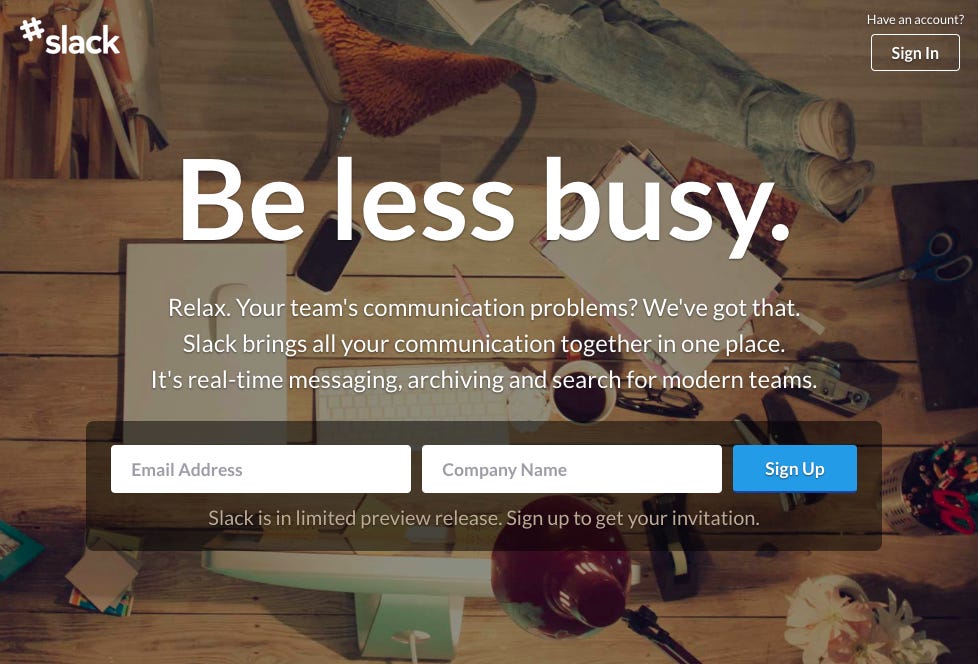
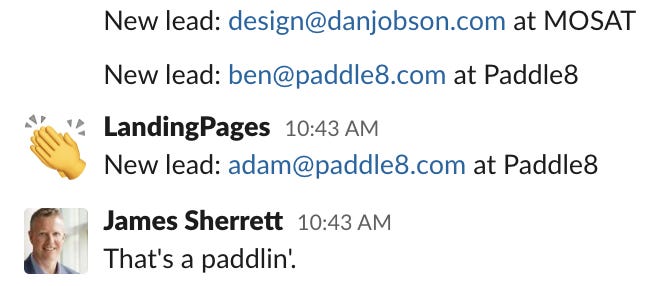
8,000 people signed up in the first 24 hours and 16,000 signed up by the end of that week. It seemed we were on to something. All the sign ups got piped into the #leads channel and we combed through them for gems: Walmart Labs, Boston Consulting Group, AOL, MIT, Deloitte. Sometimes we chirped them a bit.
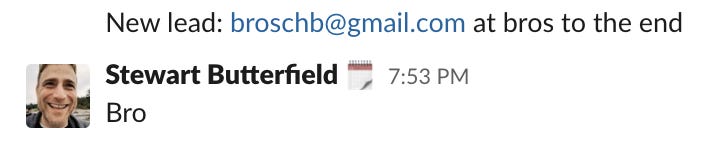
On a personal note, I saw for the first time how PR could drive attention and results on a scale I had never seen. This wasn’t tactical, IT-only press relations. This was mainstream, big time PR. If Silicon Valley was like a large royal court (and it is), with kings and jesters and (not enough) queens, we had a prince and he was well known and what he said had an automatic audience. We ran with it.
Now that we had some ‘customers,’ someone had to speak with them. That seemed like a good next place to concentrate my efforts, so I started inviting customers to try the product, then emailing and calling them for feedback. This was partially marketing, partially sales and partially support. The initiative called Everyone Does Support started because everyone actually needed to do support.
I got my feet wet demoing the product as Stewart’s sidekick and then he got too busy so the demo job fell to me. This pattern repeated itself many times.
Gradually from my conversations, some customers’ patterns began to emerge:
Everyone had some cobbled together communication / collaboration “system” that no one had decided on in any concerted way yet everyone had to use.
Everyone had to use a part or the whole of the system and felt the pain and frustration of using it to get their work done.
It was no one’s job to fix the system. No one had decided on it. No one had a budget for it. IT paid for parts of it (email, active directory, ESNs).
Email was the base system. Everyone was on email from their first day at the organization because it was tied to their corporate sign-in identity.
Some IM or chat products were added on to the email or phone systems (Skype, Lync, Jabber) as vestigial organs.
Many teams were also free to add on their own parts to the system, so products like HipChat, FlowDocks and Campfire sprung up for technical and creative teams.
No one was happy with how they were communicating.
This was the context we were taking Slack to market in. We had to figure out how to make something better, and to convince a minimum of ~5 people to try it, consistently, together, for more than a day or two. As we said at the time, Slack is a terrible single-player experience, so we had to synchronize all ~5 of the people trying Slack to get over the Suck Hump™.
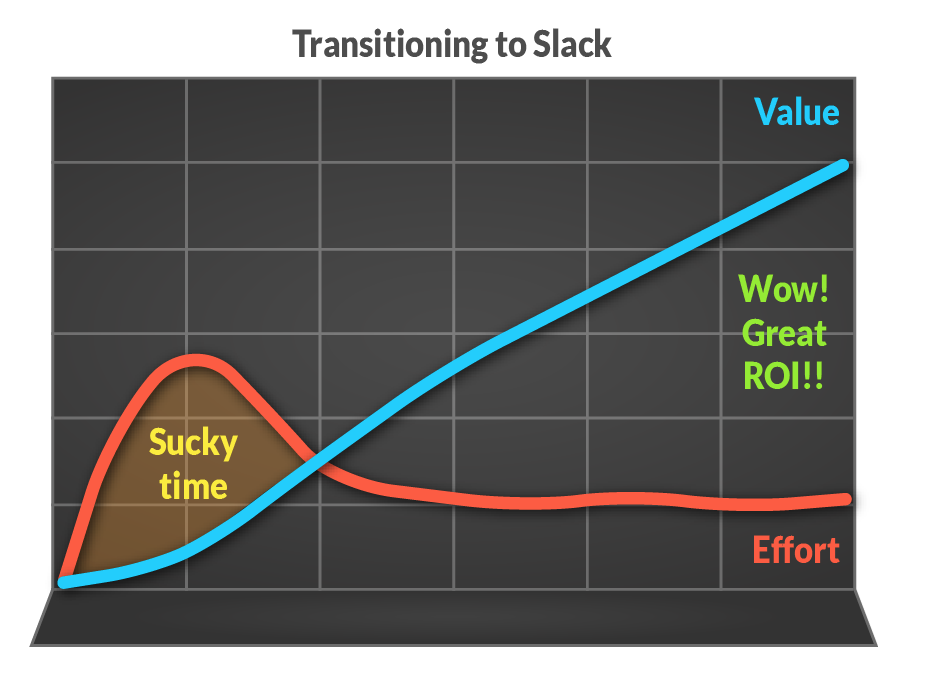
Going back to read those early customer development interviews with Beyond the Rack, Lonely Planet, Hootsuite, it’s apparent we were talking to the right people and getting good information from them because we were genuinely finding an underserved need.
And, tell me if this all sounds familiar too. From one of those interviews:
Sandy is a product manager and a director of IT for the company. When she first heard about Slack her ears perked up because of the cut down in conversational emails – the ones with just ‘Okay.’, the ones where people reply to the wrong version of an email.
This past weekend they used Slack how they wanted to — to do a major server migration. They created a private group to coordinate it and it worked really well. She is their internal advocate and has buy-in from development and support and QA and IT. Those groups are really enjoying using Slack.
They’re having a little more challenge with getting buy-in from sales and management. She has a couple of people with hybrid roles who are a less technical audience who she sees as her go-between to the laggards and her test audience.
JS: What barriers do the sales and management folks see to Slack?
They have to keep it open. She tried to get them to use the app but it didn’t work for them. People said to her that it was additive — that they had to have IM plus this plus email open. She has tried telling them that Slack replaces IM and most of their email but there is resistance.
Zoom ahead 7 years from the day of that interview and we’re having a very similar conversation with a later-adopting customer. That’s how big the market for Slack is. Wow!
We were getting traction and people — once they got over the Suck Hump™ — were using the product and using it a lot.
We rolled through the invitations people had signed up to receive and ramped up invites to 50 / day, 100 / day, 200 / day. The product was getting better all the time — the rough edges sanded off and the gaps filled in. As a continual quest for us to consider, I remember Stewart asked the team: How can we maximize the surface area of the company to customer feedback?
Twitter took off for us. Customers had questions. Customers had complaints. Customers also loved the product and started proposing marriage to Slackbot. We collected 20+ proposal in the first few months. That was surprising.
We created a Wall of Love on Twitter with an end-of-life feature designed to collect a maximum of 2,000 tweets in a list. We poured the tweets in and pointed prospective customers to the link: See? People love Slack! We had to create a Wall of Love 2.
There was still too much to do and every night I went home and told my wife that the work was great and there was so much of it to do and both were true!
Saying No Nicely
To cope, we had to evolve. I started discovering the privilege of saying No to things. People pitched us things all the time and it was a joy to say No. It was incredibly liberating to say No because it meant I had the space to focus on just a few big things.
I started to see that from a product perspective, saying No was essential. Slack was an argument for a way of working in the world. Each feature added or (better!) not added was part of that conversation. The more features, the more that had to be held in memory to stay current on the argument we were making.
In the customer-facing world, I saw our product folks saying No and wanted in on the clarifying simplicity it provided. In my role, setting up a call could be a 3 to 6 email correspondence that sucked for all concerned. So I tried to put all the information and options into single message. I tried to change the context.
“Do you want to do a call?” (which inevitably was greeted with silence — our customers’ version of No) became:
Here are 3 times that work for me to do a call:
date / time 1 (your time zone / my time zone)
date / time 2 (your time zone / my time zone)
date / time 3 (your time zone / my time zone)
If none of those times works for you, please suggest a time and we’ll work to make it happen.
Once we have a time, I’ll send you a calendar invite with the meeting details and a video / voice conference link.
Everyone could choose a starting time. It was way easier than deciding if they wanted to do a call or not.
I started to treat emails as landing page copy designed to get a specific response. Subjects were the headlines. Bullets were your friend for scanning. Always start with a thank you, even if it’s just to thank them for continuing the conversation and sharing their feedback.
Saying No Nicely meant we got to spend more time, energy and emotion on the core things that really mattered, and I truly believe that mattered then as it matters now.
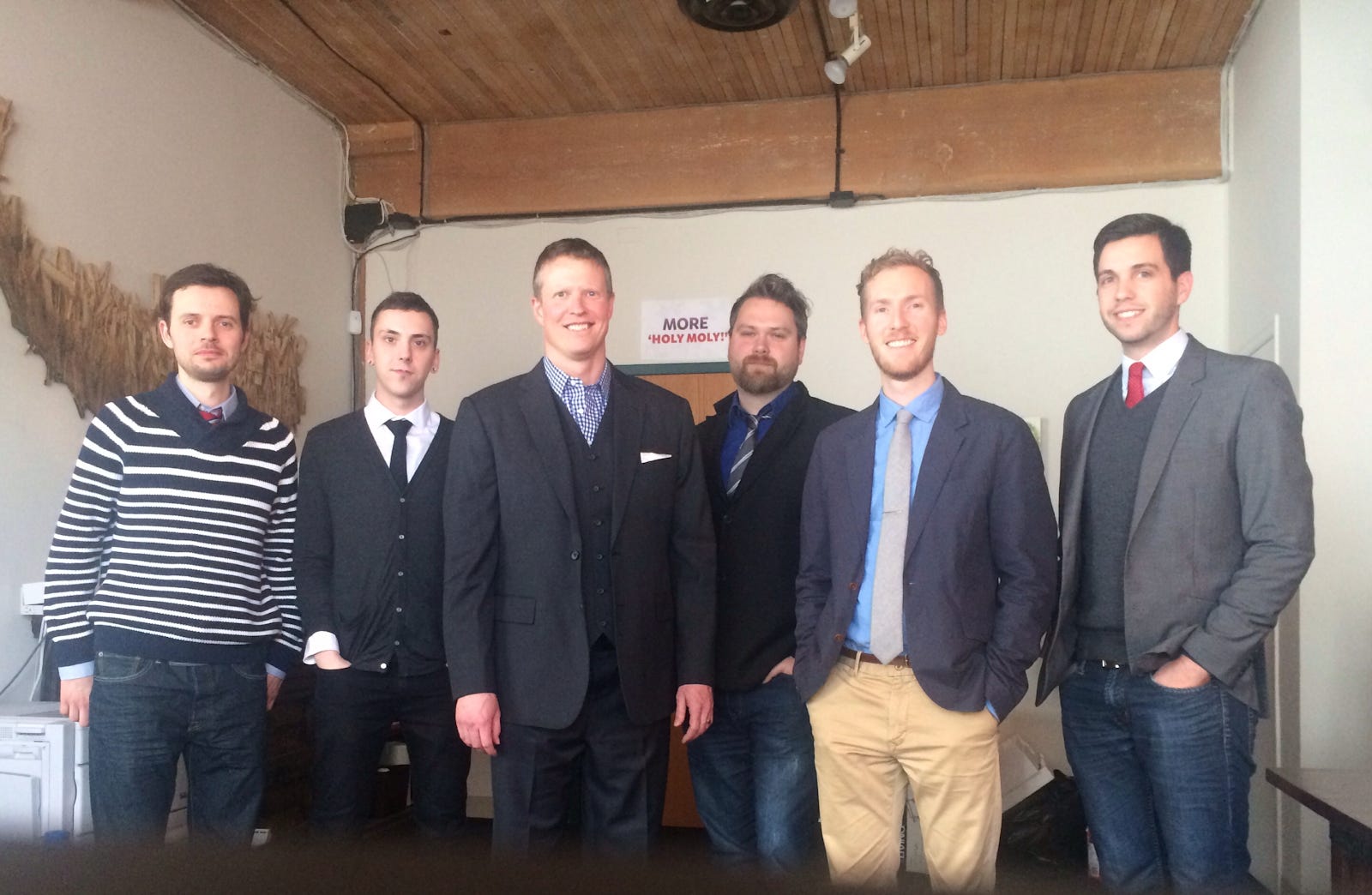
More Holey Moley
In the midst of trying to keep our collective heads above water we started to talk about the kind of organization we imagined. Now that it seemed Slack was going to be something, what did we want it to be?
A sign that said More Holey Moley went up above the door of the office. Stewart told a story about doing the best work of your life. We talked about Four Seasons’ mission statement based on The Golden Rule: To treat others as we’d wish to be treated ourselves. We shared the Disney blog post, What time is the 3 o’clock parade?, so we could start thinking more broadly about what our customers needed and how we could meet them where they needed help (and lead them, even).
I bought us a sign for the entrance to our office.
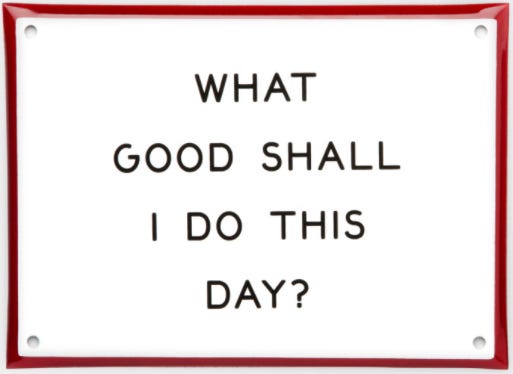
We were still pretty overwhelmed but we knew we were building something people cared about and that affected people. That was really inspiring.
We started hiring folks (or rehiring with many great people returning from Glitch). People I was talking to asked for a one pager to show to their boss, so I wrote a one pager with a pun in the title: Time to Communicate Better.
I used three classic Hemingway quotes to keep myself focused every day:
Never mistake motion for action.
The shortest answer is doing the thing.
The best way to find out if you can trust somebody is to trust them.
At the end of 2013 I went for a walk with Stewart around the seawall in Vancouver. He said to me: “That thing you’re doing working with customers, I want that to be the only thing you do. We’ll call it account management.”
“Okay,” I said and we were off to the races.
Account Management
We had a target date set for our commercial product launch: February 12, 2014. Then, we’d really see what we had. Would people be willing to pay for Slack?
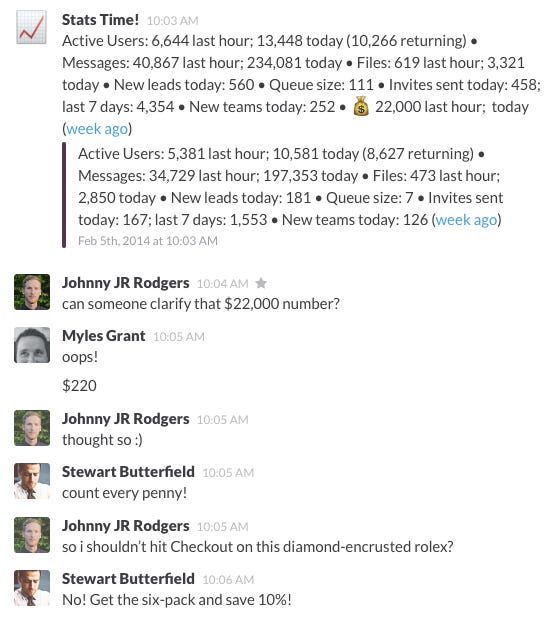
I’ll not belabour the question: yes, people were willing to pay for Slack. Right away, too. There was a queue. This is what Stats Time looked like on launch day.
At the start we gave customers credits to pay for Slack, or some of Slack. Just for using Slack! $100. $250. $50. There were experiments run.
We gave away credits like they were free. Like virtual money collaboration fairies we sprinkled them on accounts and then told the accounts about them to see if they were interested in trying the paid product. Really, they were just deferred revenue.
We even let customers earn their own credits through the Give 100 / Get 100 referral program. The credits were a terrific nudge wherever there was underlying usage and value in the product. People signed up.
And we didn’t discount the base price. When people wanted a better price for upgrading all 80 users at a company (I remember you, Saucelabs), we negotiated with credits. When they wanted to be invoiced for their payment instead of paying by credit card, I created an invoice template in Word on my desktop and output a PDF. When they were ready to pay, I created a Bug in our homegrown Bug Tracking System, assigned it to Myles or Cal and they did the backend upgrade thing.
A few days before we launched the paid product we knew we had lots of teams that wanted to upgrade. One of the largest was Walmart Labs who had ~3,000 users registered on Slack but with only ~1,100 active users. If they were going to upgrade, some admin would have to go through and deactivate ~1,900 users so they didn’t get billed for all of them. That seemed like a shitty task, so Cal wrote the code to check for active users and then only bill the customer for those active users. We wiggled around the active user rules to get them mostly right, and then launched the code to coincide with the product launch.
Over the next few months I must have explained how our active user rules worked 100+ times. People loved it, but they were also confused. It removed risk for them and let us say, “If a user doesn’t use Slack, we won’t charge you for them.” I started calling it the Fair Billing Policy because it made it sound fair and official and like it wasn’t up for debate. So that became the name.
We were in business now. We got a CFO and I started reporting to Allen Shim. We did an offsite in Sonoma where I met in-person many of the folks I had been working intensely with for months. They were good people. Ben Jenkins had a quadcopter drone that rose above the grass, above the roofline of the hotel, above the water tower of the Fairmont Sonoma, almost out of sight, shooting a video at golden hour that was so crisp and clear it could have been in an IMAX film. Banjos and guitars and ukeleles came out later.
We got around to doing something about swag. We had talked about socks and now we were making them. Cory designed a great pattern for a Slack tartan and I figured out getting them made. People liked the Slack socks whose first version of 250 pairs was similar and yet not similar to their second version, and whose second version with their custom-dyed yarn and custom weave went on to get replicated many tens of thousands of times. Maybe 500,000+ pairs are out there now?
We aspired to an experience of sprezzatura for our customers, as they say in Italy. We raised some money and everything rushed ahead in the blurring reality of the doing of the business.
So yeah, we tried Slack
We started some promotion to tell people about Slack. Sandwich Video was the hot thing. So hot, in fact, that Stewart’s original outreach to them was met with crickets.
Eventually, we got in touch with them. Adam Lisogor came to meet with us. We worked out a script that was both funny and topical. It had some character while also following the standard product intro video format — introduce a problem and what’s at stake, insert product as solution, resolve the tension of the problem with how much better the world is now with (product).
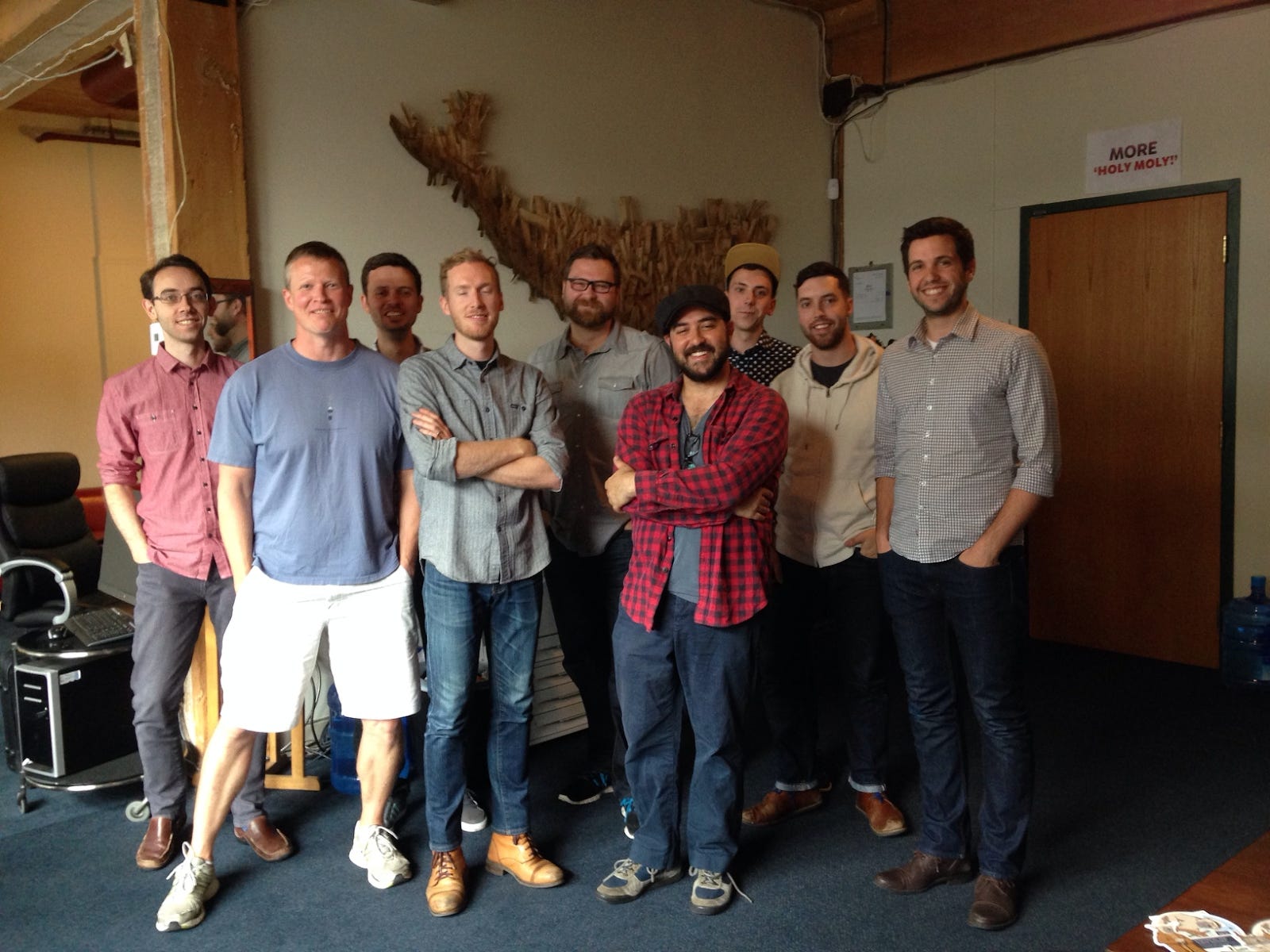
We watched the video final cut in our office with Adam. It was great. But it had no title. We watched it again. In the silence that followed I quoted the video, “So yeah, we tried Slack.” and we had our title. (Amazingly, the sequel is really terrific – Sandwich works from home – in Slack.)
The business rushed onwards and onwards. We got to $10-million in ARR by October of 2014 and ran a report to find that ~70% of people signing up never got in contact with anyone at Slack. They came to Slack.com, signed up, tried the product, invited folks to try it with them and upgraded. Yay!
For the balance of folks, they needed help with Slack. They needed to understand what it could do for them, how it fit into their day, and how they might use it. Those were the people I worked with.
Within that ~30% of upgrades we touched, about half needed 1-3 touches. They had quick questions or simple processes to upgrade. The other half needed 20+ touches to upgrade. These were the characteristics of Enterprise customers and we could see it in the barbell distribution of contact points. We had to hire people to help the Enterprise.
So we did: Account Managers. Kim Graves joined in Vancouver. We pulled my desk away from the wall and she sat on one end and I sat on the other. Accounts team: activate! AJ Tennant joined in SF and flew to Vancouver to meet our fledgling gang. We made room for him on the same desk. He sat on a box and we made it work.
People with sales experience started to apply and to teach us in their interview (they had to demo Slack to us if they got to the final stage) better ways to sell our own product. That was a surefire indicator they were solid candidates. Dave Macnee joined. Christina Meng joined. Mike Clapson joined. Kyle Shackley joined. Maggie Hott worked for Eventbrite in SF and came to Vancouver for her customer Lululemon. I met her in the same JJ Bean I had met Stewart at 16 months earlier and she had a bag of Ghiradelli chocolates for our team. Maggie joined.
We created a scorecard for what we were seeking in candidates and scored them on Communication, Culture, Trust, Poise, Savvy and Grit. That seemed like a good framework. Certainly better than nothing and better than anything else we were using before.
The business continued to rush onwards and onwards. We started to get more inquiries from all over the world. Doing calls at 5 am was a bit of a pain. Expansion was in the cards and someone had to go to do it.
My wife and I had always wanted to live and work internationally, so we signed up to move to Dublin to open Slack EMEA.
Slack EMEA in Dublin
I moved to Dublin in April, 2015, with my wife and our son to start the Slack office. Dublin was growing and US-tech companies were a major driver. We had 3 people at Slack Dublin to start: me, Hanni and Aaron. We set up in a co-working space in the Guinness Storehouse beside the space Etsy had just vacated for a bigger office.

A pretty specific process existed for US-tech companies to set up in Dublin and we plugged right in.
Start the first office and focus on sales and customer service teams. Grow to a few dozen folks.
Get your second office, expand the sales and customer service teams and add representative business services: finance, HR, accounting, office management.
Start to develop specific market expertises for your top countries / regions.
Google had ~3500 employees. Facebook had ~2000. LinkedIn had ~1800.
Having that template proved helpful because everyone we worked with was well versed in it. Service providers for payroll, legal, accounting and so on knew the process. Recruiters knew the process. Candidates knew the process. We were a startup on the scene and we had to find our place accordingly.
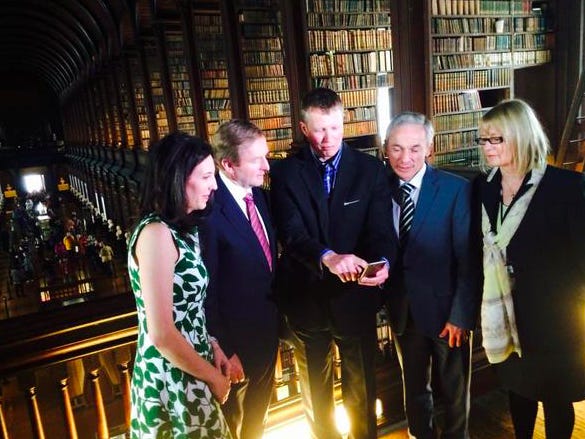
First up, we had to tell people we had opened the office. We joined the Irish American Chamber of Commerce and that right there is a serious business network. We launched Slack Dublin in the Long Library at Trinity University with the Irish Taoiseach (Prime Minister, pronounced “tea-shock”) and prominent ministers.
We had to start again with the basics — tell the world we existed, why our product mattered, what it did for our customers, what we were arguing should be different about the world of work. People were skeptical too. Were we like a Facebook for businesses? Were we a product for developers? Or just for startups? The context they were trying to fit Slack into was new and different.
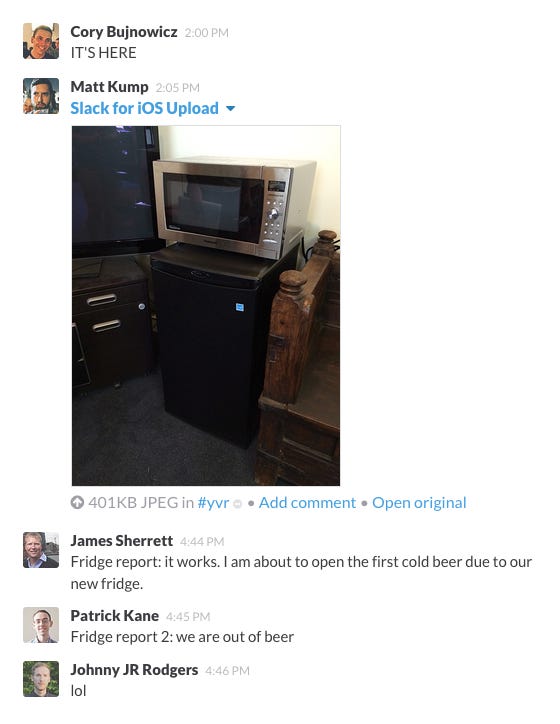
For me, the day to day was also like a step back in time to the original Slack YVR office. We had no plumbing or kitchen in the office. Getting a fridge into the office deserved a celebration. Bathrooms were common to all the offices in the building and an adventure to get there and back — a minimum 4-minute round trip, in case you were booked in back-to-back meetings.
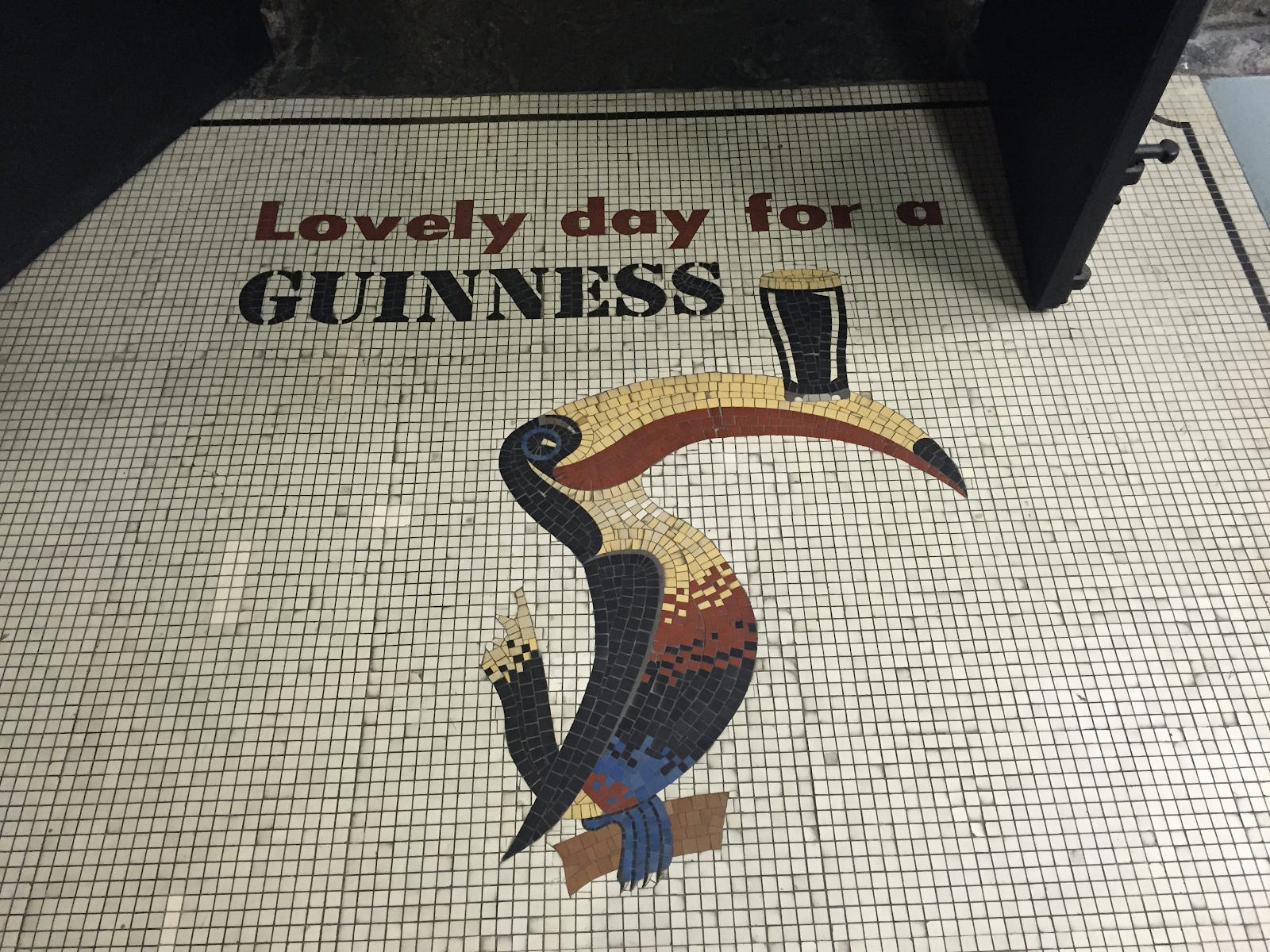
On the upside, the journey to the bathrooms did mean you walked over a lovely Guinness toucan mosaic.
Each day felt like a struggle to find the right thing to work on because we were lucky enough to have so many things to work on. We were starting fresh in building the business with a huge support crew, strong reputation and customer traction. Significant tailwinds.
Our team was still called the Accounts team and we had one role to hire for — account manager — and we were hiring as quickly as we could. Successful candidates were expected to be the single point of contact for a customer, able to do a technical demo, answer a security questionnaire, negotiate a contract and do discovery, for starters. Candidate interviews often happened walking the cobbled streets of The Liberties and horses and horse carriages were common. Watch your step!
Again, the experience in memory is a blur. I tried to walk a different route to work each day to see the city. I learned each working day had to be parcelled out into time zones: first thing in the morning for the local Dublin team, midday to prepare for the Americas team, late day for meetings with HQ.
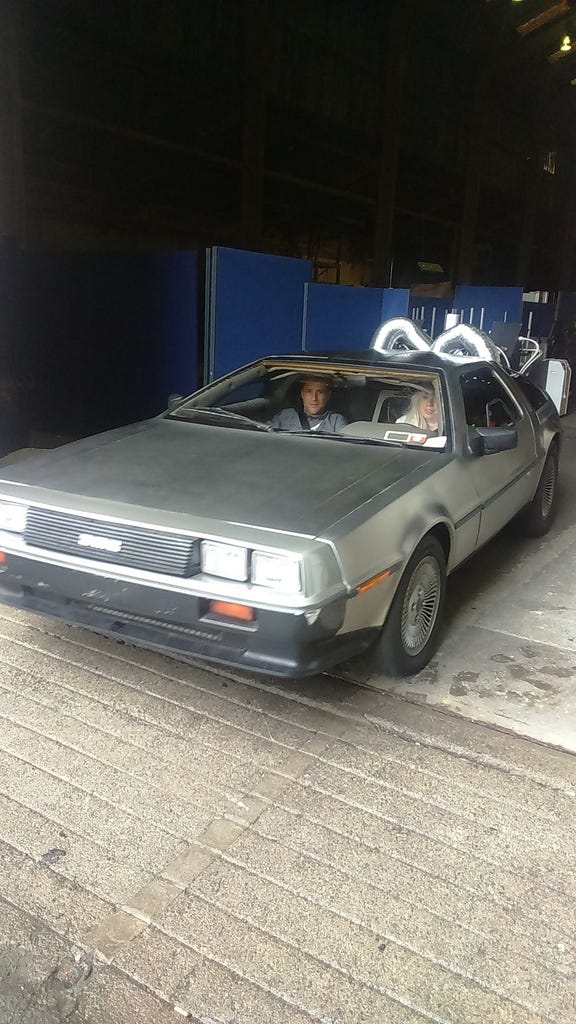
Stewart visited and hosted an All Hands from the Dublin office lounge that we called The Snug. He also rode, Back to the Future style, in a DeLorean with Davina.
We were building something and learning what we needed to build at the same time.
Starting a Culture
We started from pretty much a blank canvas to create what we thought could be Slack’s culture in Dublin and Europe. We had the mission statement and the 6 values but we didn’t know what a new office had to do because we’d never opened a new office like this — in a new culture and continent.
What would be the same as Slack’s global culture? What would be unique to Dublin and Europe? It was a consistent question and I’m not sure it’s even settled today — there’s just the guidance of more past decisions to point to.
The most important parts of the culture were the people we hired, and on that front we were incredibly fortunate. To be clearer: I was incredibly fortunate.
Paul Murray was dogged after customers. Alia Lamaadar joined the team with her tenacity and her name was 60% As. Alison joined. Bernie joined. Panos joined. Julian joined. Each brought an incredible willingness to learn and push us ahead — to be flexible and adaptive and to put customers first.
I had to learn how hiring in Dublin was different too. The questions I had asked in US and Canadian interviews got a very different answer. For example, “Tell me about a time you had to lie at work” shocked people so much they were unable to answer. Candidates held back telling their stories. We started scheduling longer interviews so they could get comfortable with the process and settle in to tell their story. They had to feel safe to shine.
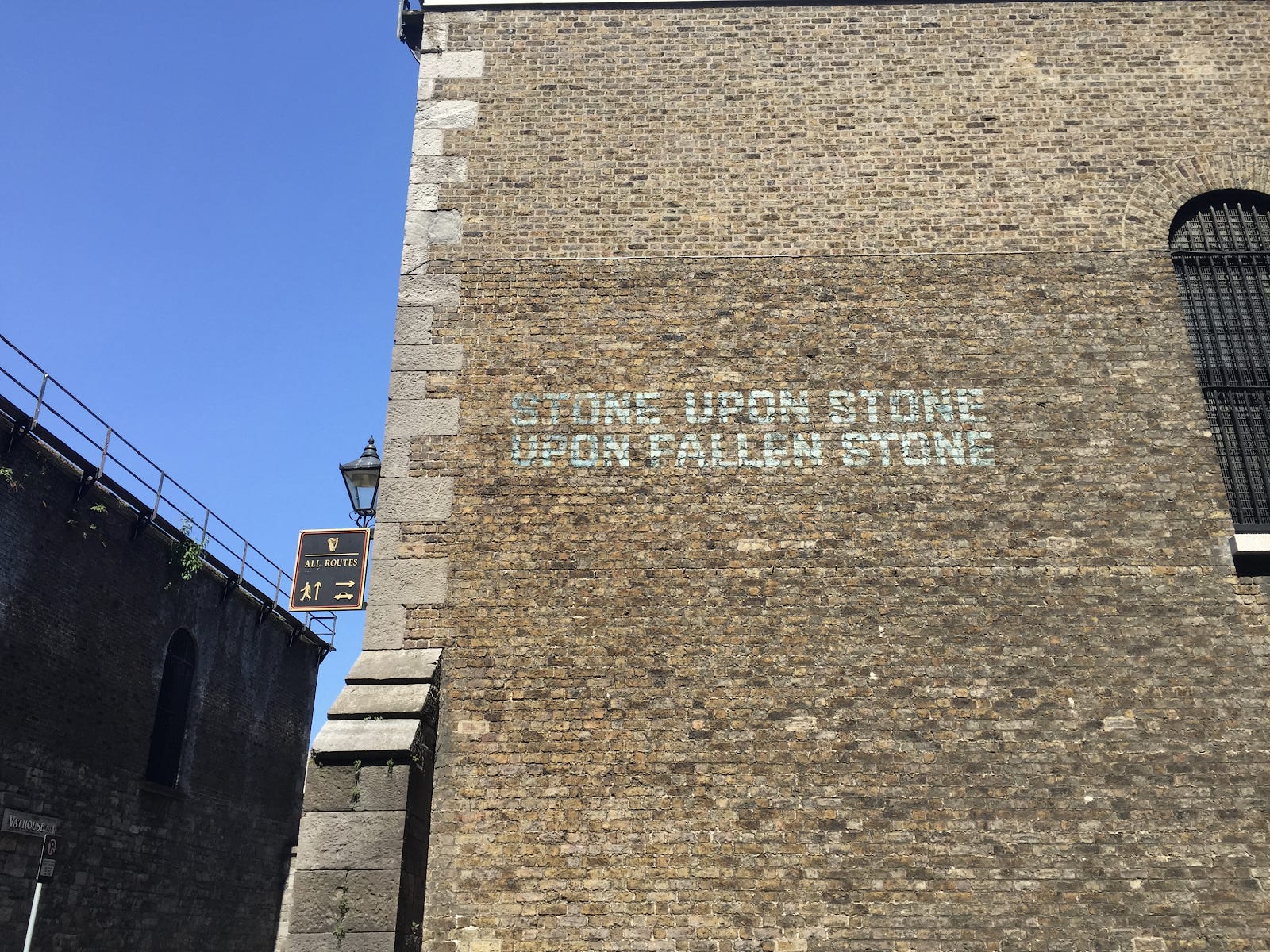
We tried to strike a balance on what we carried over and what we created. We celebrated global Slack traditions like Caloween. We created new local traditions like Small Hands.
On the business front, we ran to talk about our business wherever we had the chance. “EMEA: Europe, Middle East, Africa” revealed itself as a construct for convenience. There was no EMEA to the outside world. That’s just how we (and every other US tech company) talked about it. Even the EU was incredibly diverse with 27 member countries and 24 official languages.
The fun with acronyms didn’t end there either. The way software companies parcelled up EMEA revealed itself as we built the business: DACH was Germany, Austria and Switzerland, Benelux was Belgium, Netherlands and Luxembourg; the Nordics were Norway, Sweden, Finlay and Denmark; MENA was Middle East and North Africa. It was a big, big world.
Customers and chances to tell the world about Slack took me to London, Copenhagen, Oslo, Cardiff, Madrid, Frankfurt, Berlin, Amsterdam, St. Andrews, Edinburgh and beyond. London, London, London. As a bonus, I was sometimes lucky enough that my family came along and we made a long weekend of it — cycling on Copenhagen’s paths, hiking in Scotland, swimming the Oslo harbor.
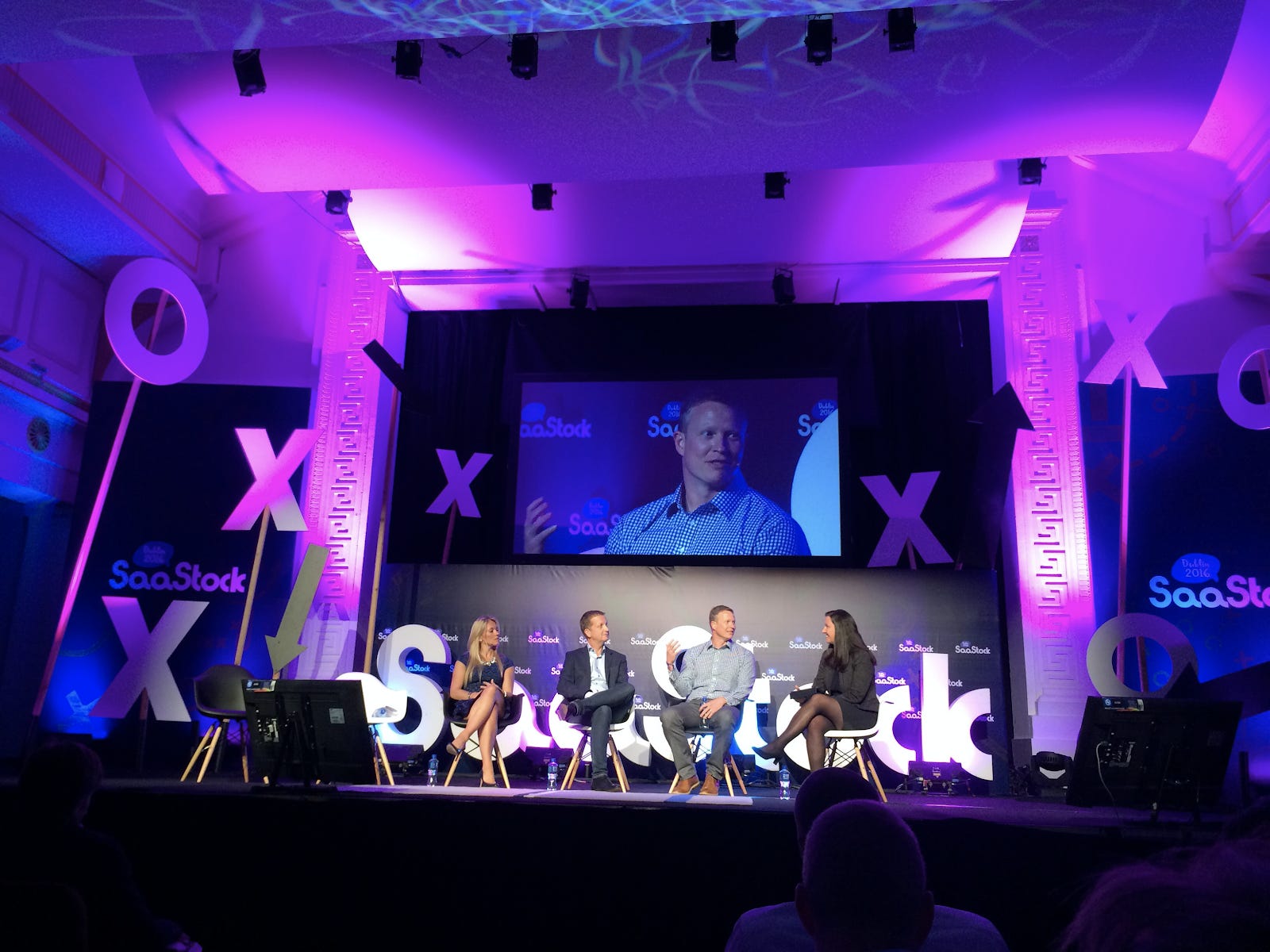
We pressed on to spread the word. There was a terrorist attack in Paris and Hanni (who led our customer experience team and spoke passable French) and I were off there the following day to pitch to LVMH. The high streets around the Champs Elysée were lit up for the Christmas holidays, expecting throngs of shoppers, yet empty and yawning.
We grew the teams and filled our starter space and moved to a shiny new Dublin office in the same building and neighbourhood as companies we’d grown to be considered peers with — Dropbox and Twitter. We were following the process. We were building the business. We were telling jokes. Did you know Ciaran ran a marathon?
Other global changes happened around the same time. On the first Accounts Sales Team Offsite we became the Sales team (thank you for hanging with us Success until you got top billing too). We opened in Melbourne, Australia. We started to hire in London and planned an office. Rav started before the office opened, so he always claimed his dining room table as the first Slack London office. Bob Frati started as our new global leader.
In Dublin, I started to look for someone to take over Slack’s sales leadership in EMEA. Many Dublin coffee shops saw my face. We weren’t in a hurry but we weren’t slow either. Bob visited for a week and we interviewed candidates together in Dublin and in London. We were also looking for a sales leader for the UK. Our appetite for excellent candidates was insatiable. We found folks and needed more.
Phil started in Dublin to lead the SMB sales team and it was a huge help to me. We signed up key EMEA accounts like Schibsted, Deutsche Borse, Adidas, Spotify, Financial Times, Daimler, Paddy Power. We crossed $10-million in ARR as a region. Stuart started to lead our UK team. We moved to a new London office. Johann started to lead our EMEA team. A global sales team started to take shape with all the Enterprise Software rigour needed to continue to propel the business.
It was early 2017 and Dublin didn’t need two sales leaders. What was I going to do next? I wanted to have an impact and work with customers. I had to find something new to do.
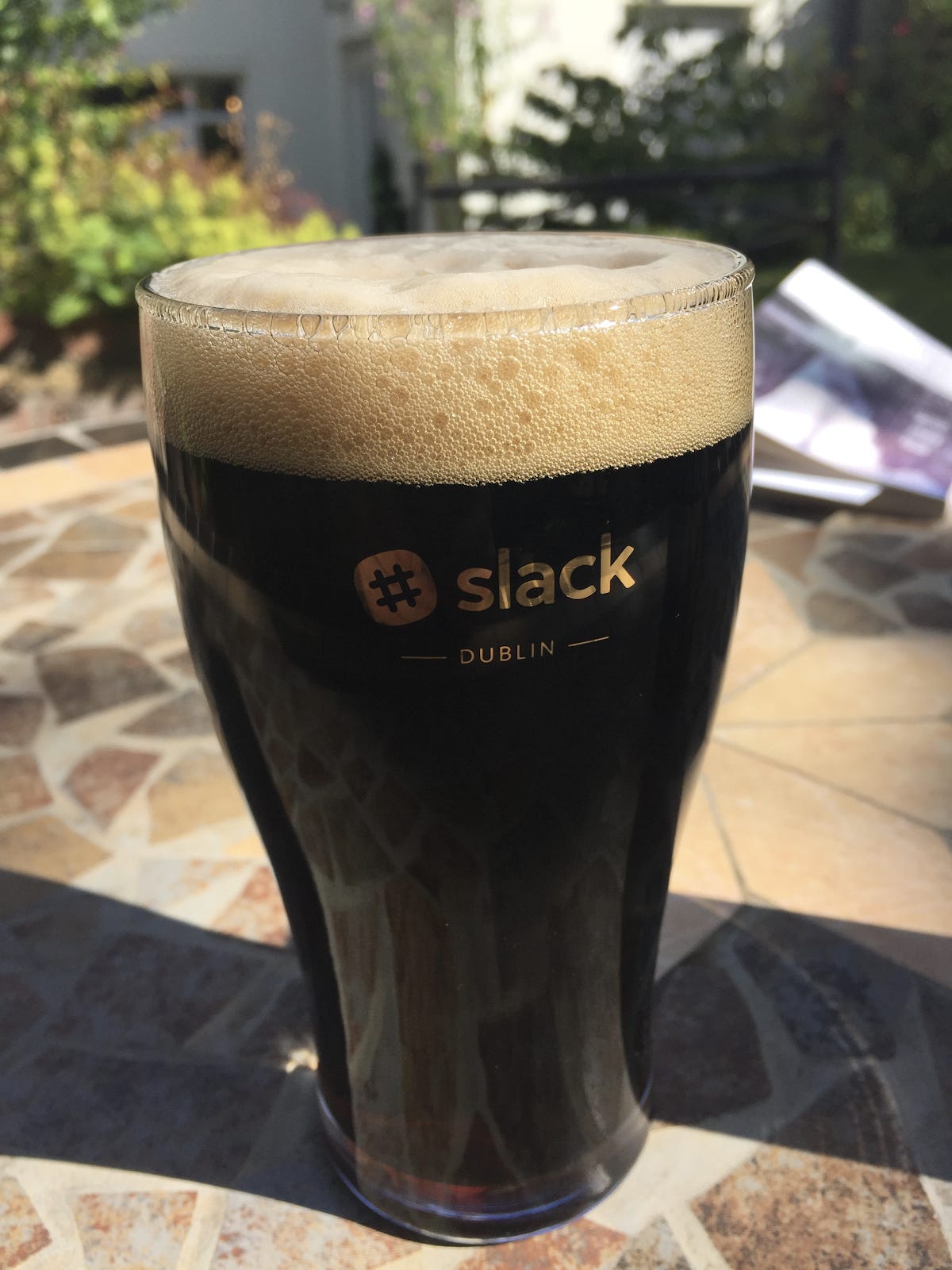
When I look back at my time in Dublin I keep coming back to the first All Hands hosted by Stewart from there. He asked me what was the best thing about our work and the answer was simple: The people. It’s the people in Dublin that I miss the most and will continue to miss the most. I miss you folks!
Executive Programs?
At the beginning, I confess, I had no idea Executive Programs and EBCs (Executive Briefing Centers) even existed. Then, the more I learned, the more interesting it became as a place to have an impact and continue to tell Slack’s story. I joined up even before I left Dublin.
Each briefing we ran was a mini production. I loved working both behind the scenes to enable and coach others to be the stars and role players, and occasionally doing some on-stage work myself. We parachuted into an account, learned as much as we could as quickly as possible, packaged that up for all the people who needed to be involved, and helped to run the show. Then we gathered feedback and exfiltrated to run the next briefing.
We started with one EBC in SF and expanded to three others in Tokyo, NYC and London. We started doing a few dozen briefings a year and grew that so in 2019 we did over 500 briefings. After crunching the numbers we learned that doing an EBC with an account improved the close rate of an opportunity from 33% to 77%. That seemed very good.
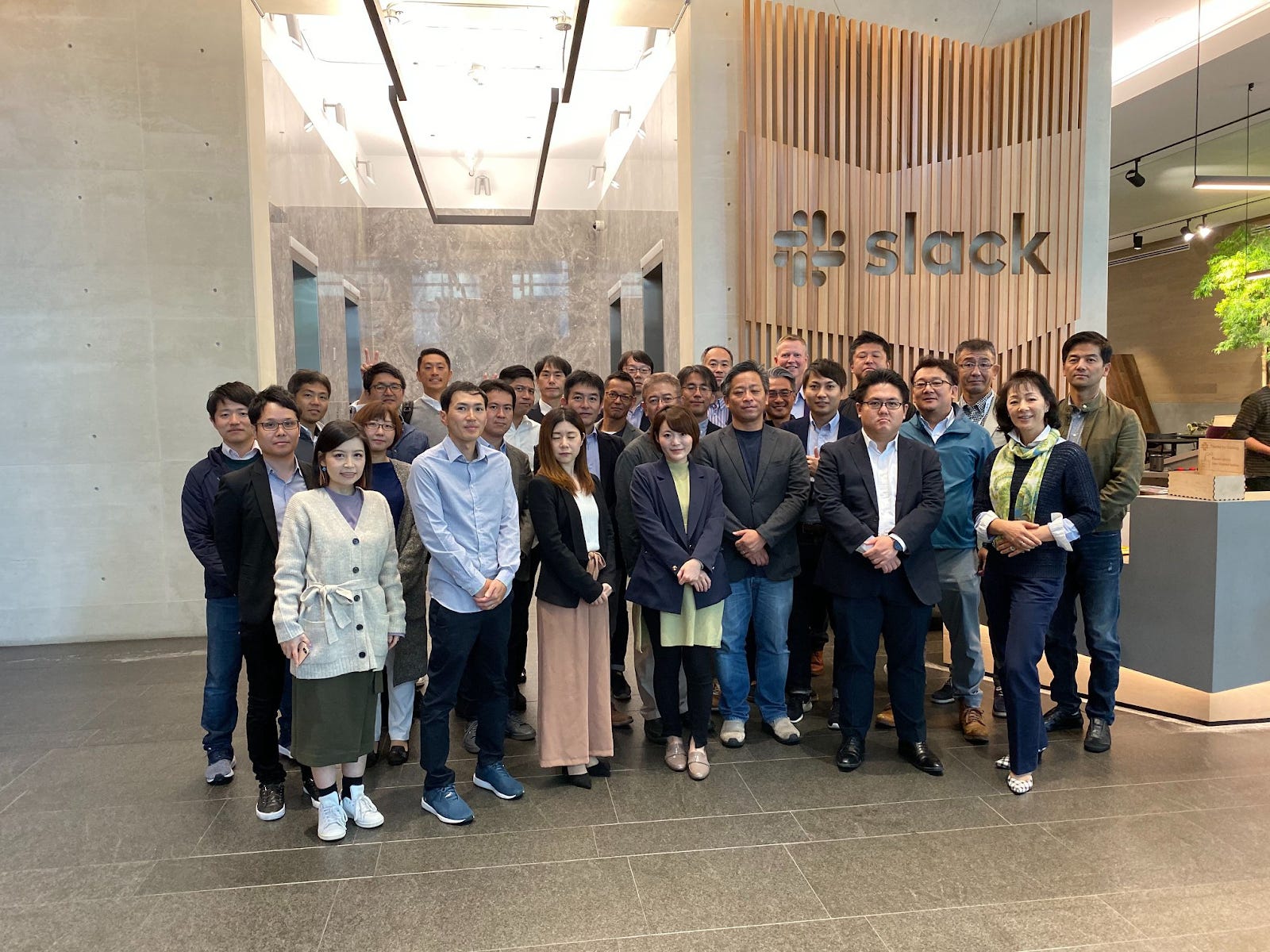
“Innovation Tours”
We also started getting asked to host “Innovation Tours.” These were groups of folks travelling to Silicon Valley (and some to Dublin or NYC as well) to learn from leading companies.
These Innovation Tours seemed like (a) something we could do well and (b) something that would introduce Slack to new people. And since no one stopped us from doing them, we started hosting them just to see what could happen.
Here was a whole other industry I had no idea existed until I was ingrained in it. People started visiting Slack in Innovation Tour groups from France, Germany, Sweden, United Kingdom, Thailand, Japan, Australia, New Zealand and beyond. They loved to hear the Slack story, to tour our offices and get a glimpse of the insides of a world-class technology company. That was us.
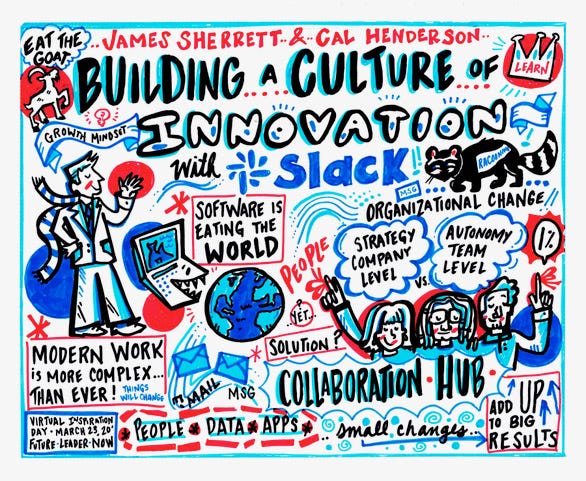
As we kept doing Innovation Tours we discovered there were 3 main types of groups and they were roughly (business wise) in this order of value:
Companies sending their execs on a learning retreat — the C-suite of ThyssenKrupp, the international country GMs from Thomson Reuters, product leaders from Daimler.
Like minded executives seeking innovation and travelling together with a shared organizing group — the Loire Valley Chamber of Commerce, Pasona HR consultancy, McKinsey’s banking clients.
Graduate-level education groups who were mid career and working for large companies — MBAs from London Business School, Cass Business School Exec MBAs.
We built a scorecard to estimate and track the effectiveness of our efforts. The scorecard also acted like a decision journal for our past judgements. We declined as many innovation tours as we accepted, even as we grew the program and our reputation with the tour organizers.
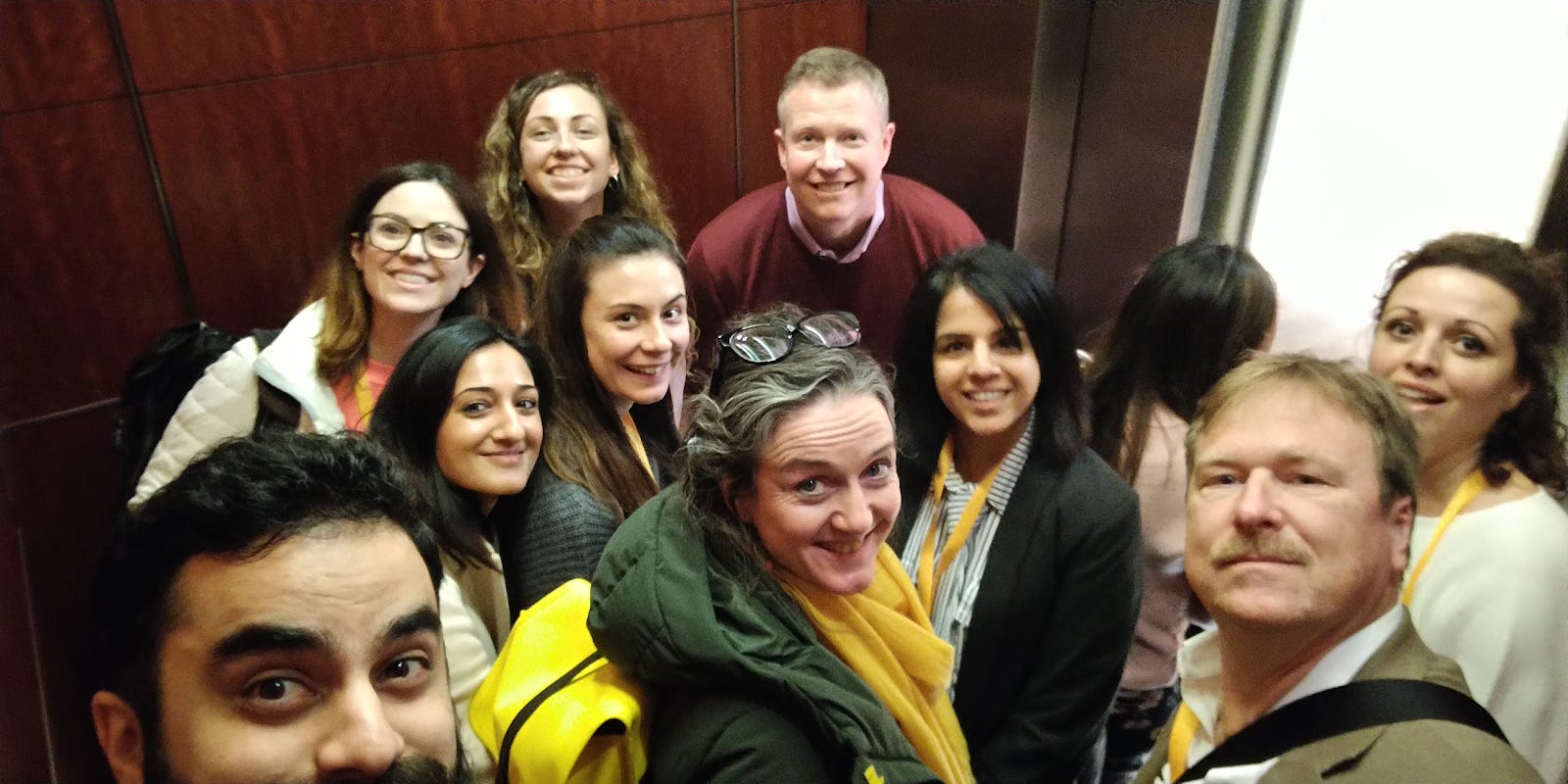
In 2019, we delivered over 50 innovation tours at Slack offices around the world and connected to over 550 new executives. These were slower developing leads that led to closed deals over the course of months and years. The more of them we could do, the more chances we had to tell the Slack story, build the value of collaboration and be part of prospective customers’ future options.
We made our goal to infect them with a mind virus: people were their largest investment and how well those people worked together — how well they collaborated — was the biggest performance differentiator possible. Therefore, collaboration ought to be the highest priority they could work on and Slack was the clear leading option for collaboration. We meant all of that only in the most benevolent of ways.
On a Personal Note
The work I have done over the last 3 years with the Executive Programs team has been some of the most fulfilling work of my career. We are a small and mighty team that aspires to a very high level of craftsmanship in all we do. I’ve found that incredibly inspiring and the best kind of hard fun to get to work on.
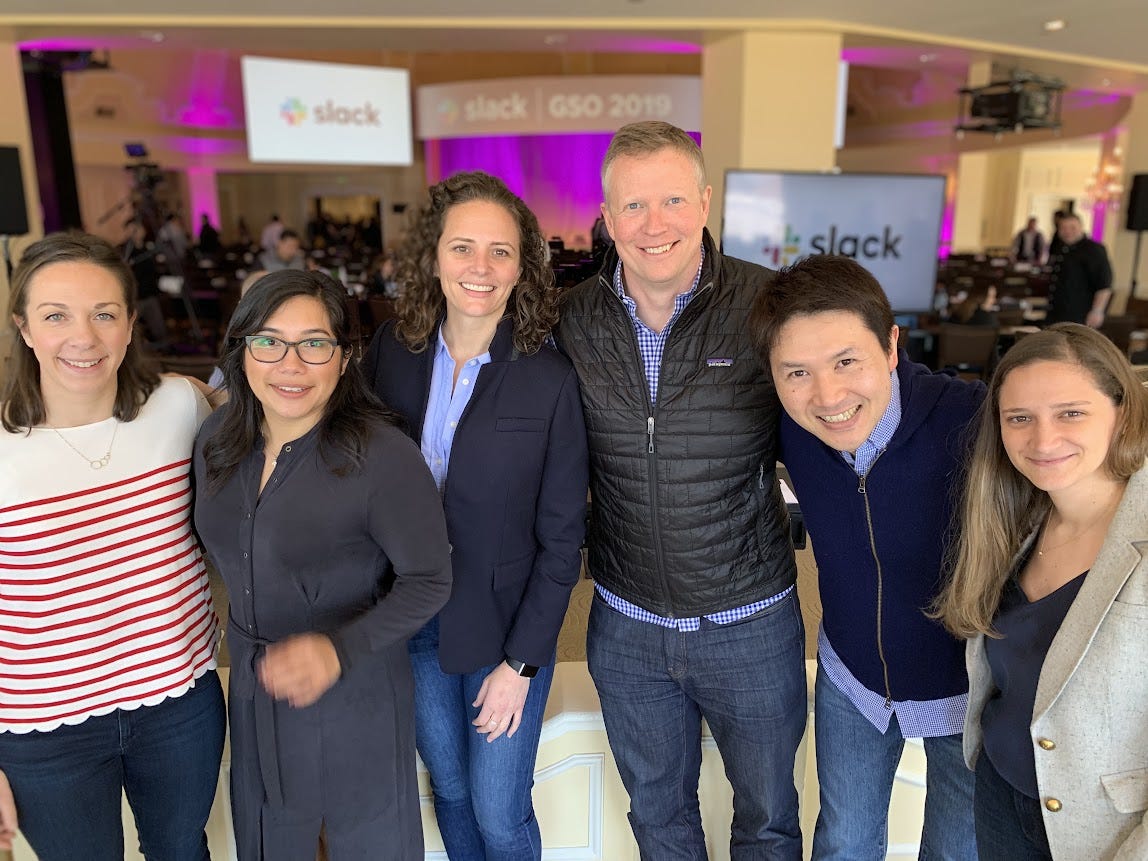
My boss was Marnie Merriam and she was the best boss I’ve ever had at any company. We coached each other. We acknowledged what we knew, what we didn’t know, and trusted each other to do our respective best work. I have enjoyed our working relationship immensely and will miss it.
And the executive programs team — they were always a pleasure to work with and achieved a standard of craftsmanship that I marvelled at. Team: You held me to account. You supported me. You challenged me and helped me be better. You laughed with me and made me laugh. Thank you.
I also had the incredible privilege to work with folks across the organization who always brought a mix of smarts and strengths, opinion and humility to each bit of work we did. They were collaborative and hard working. It was all 4 of the Slack attributes at once.
To our leadership groups, our leadership group’s support teams, our sales leaders, our product folks, our expert discussion leaders from across the business, our business support teams: thank you. Your partnership was invaluable to my work and you were excellent to collaborate with. One last time: thank you. I have been so incredibly lucky.
Aiming Towards Something
So, what now, fella? It’s certainly not retirement. Best to aim towards something, not just leave. Maybe it’s career 2.0. It’s a portfolio of things I want to pursue. It’s being a beginner again. It’s finding the beginnings in a few things.
More specifically, it’s 4 things, so far:
Advisory work — I’ve started working with startups to help them. I have 2 I’m working with today and I anticipate 4-5 is the right number, in the Seed or Series A stage, with 2-20 employees. I think.
Writing — It’s kind of where I started and where I’m often happiest — working on words and puzzling through ways to tell stories. Years ago I wrote a novel and made no money and I’ve always thought of that as my first novel. It’s not, yet, because I’ve not written another one. So I’d better get on that.
Personal projects — Being a beginner. I have a crazy idea for a sculpture called Polytropos that retells the translations of the Odyssey. I have many other ideas. I will suck at the start, then get better. I’m playing drums.
Volunteering and good work — To start, with the First Nations Technology Council. Then, water testing for Pacific Salmon Foundation. Mosiac to help new immigrants. Coaching kids sports.
Slack has been the best place that I’ve ever worked, by far. I feel like I was made for the work I did at Slack. I had trained all my life to be able to do it and it trained me to be better.
When I moved back to Vancouver from Dublin one of the things that I kept hearing in my mind is that work is love made tangible. Work is love made tangible. I always wanted to show people how much they meant to me in our work together.
In that spirit, this work has been the most rewarding and generous and hard fun I’ve ever had. I’ve loved working at Slack and with the Slack team.
And I believe the future for Slack is actually stronger than ever. I wish each of you the best of luck: tell the Slack story. I will be watching you do amazing things.
Thank you for every part you played in the last 7 years!

Up next — Questions That Remain: Thinking about luck. Money and MacGuffins. Leaving before it’s time.
And where to next next?
I still want your direction and feedback on where A Slack Story goes next.
Please take 1 minute and tell me what you’d like to see next from A Slack Story.
Thank you!
I could feel the energy and the adventure through every line. Seven years at the center of a rocket ship is something rare. Congratulations on living it, and for taking the time to write it all down